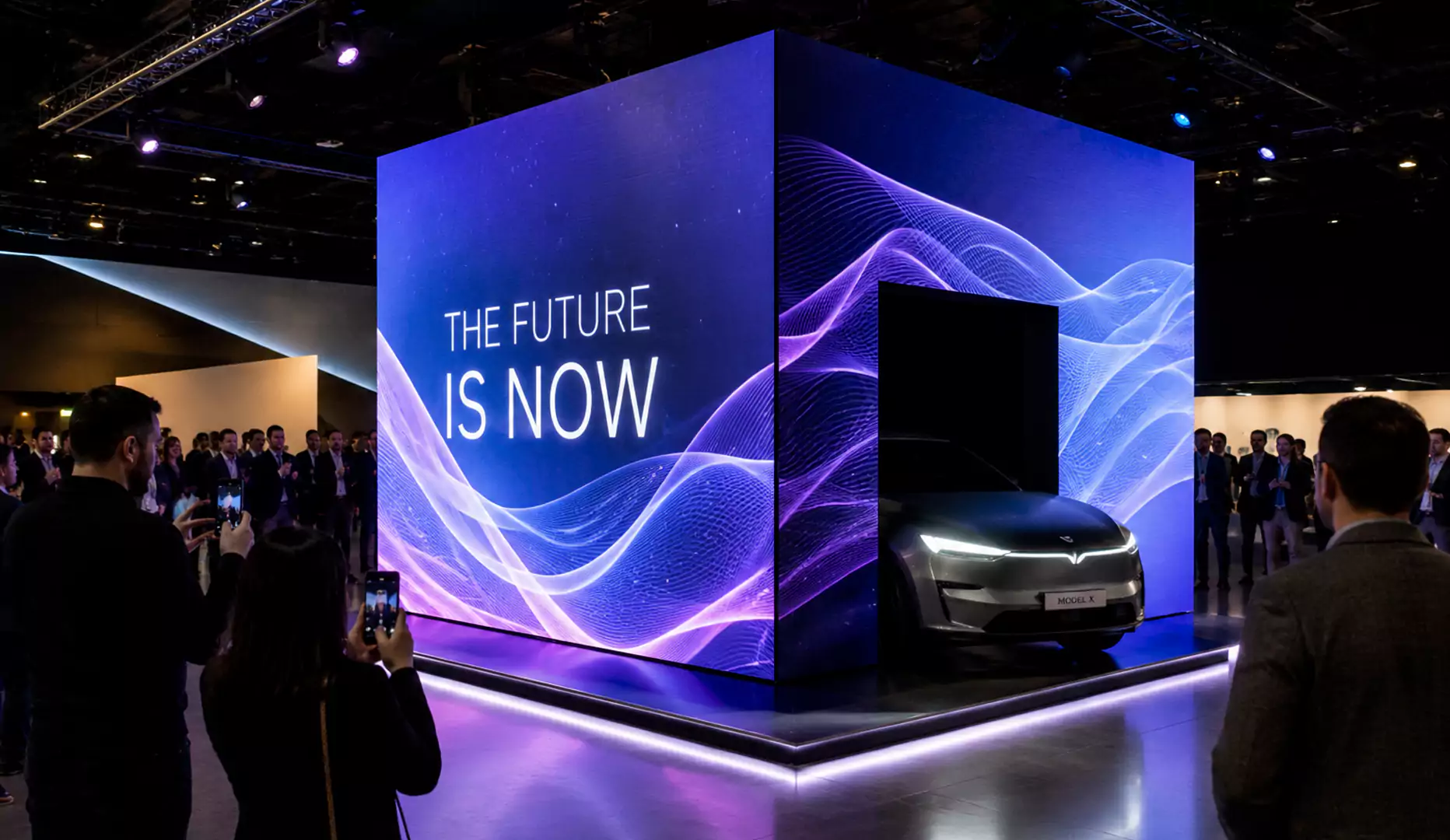
Modular LED cube hire helps product launches create a bold multi-sided reveal using high-resolution LED panels, synchronised content, technical support and venue-ready planning.
Modular LED cube hire for a product launch uses interlocking LED panels to build a multi-sided visual display with synchronised content on each face. It helps UK brands create attention-grabbing reveal moments at venues such as ExCeL London, Olympia London, Manchester Central, Birmingham and Bristol.
A product launch only works if people remember it.
That is harder than it sounds. Guests arrive distracted. Event spaces are crowded. Phones are already in hand. A standard screen may support a presentation, but it rarely creates the kind of visual moment that makes people stop, film and share.
That is why modular LED cube hire has become a serious option for UK product launches. A modular LED cube turns the reveal into a physical centrepiece. It can be seen from several sides, used as a brand beacon, wrapped in synchronised content and adapted for different event spaces.
Unlike a flat LED screen behind a speaker, an LED cube works when people are standing, moving, queuing, networking or walking a show floor. That makes it useful for product launches, brand activations, corporate events, live event experiences, exhibitions and outdoor events where attention is hard to earn.
This guide explains how modular LED cube hire works, when to use it, what to brief, how to plan content, what technical details matter and how to measure success after the launch.
What Is Modular LED Cube Hire for a Product Launch?
Modular LED cube hire is the hire of LED panels that are built into a cube-shaped visual structure for a product reveal, brand activation or live launch event.
A modular LED cube is made from connected LED panels. Each panel locks mechanically and electronically to the next one. Together, they can form a flat wall, a curved display, a tunnel, a backdrop or a cube.
For a product launch, the cube format is especially useful because it gives you a single visual focal point that the audience can walk around. Instead of forcing people to face one screen, the cube creates visibility from several approaches.
A typical modular LED cube may include four LED-clad faces driven from one media server. In more complex builds, it may include a top face, an LED floor, a suspended cube or a walk-in structure. For most product launches, a three-sided or four-sided cube gives the strongest mix of impact, practicality and budget control.
The important point is this: an LED cube is not just another LED screen.
It is a launch stage, a reveal tool and a visual display structure in one.
Why Do Product Launches Use LED Cubes?
Product launches use LED cubes because they create a strong reveal moment, improve visibility and give guests something worth photographing.
A product launch has to compete with noise, movement and short attention spans. At large venues such as ExCeL London, Olympia London or Manchester Central, your launch may be surrounded by exhibition stands, screens, brand displays and live presentations.
An LED cube helps because it gives the space a clear visual centre.
It can support:
- A Stronger Product Reveal
A cube can hide, frame or introduce the product before the main reveal. The content can build from teaser visuals into a countdown, then shift into the hero product moment.
This feels more considered than simply showing a product on a flat screen.
- Better Visibility From Multiple Angles
A flat LED wall is strongest from the front. A modular LED cube can work from several directions, which is useful at exhibitions, activations, networking events and open-plan launches.
- More Social Media Value
LED cubes are naturally camera-friendly when the content is planned properly. They give photographers, videographers and guests more angles to capture.
- Stronger Brand Recall
A cube gives the launch a shape. Guests remember the structure, not just the presentation.
- Flexible Use After The Reveal
Once the main reveal is over, the cube can keep working. It can show product features, QR codes, demo prompts, testimonials, campaign visuals or sponsor content.
For more ideas around audience attention, the same strategy sits naturally alongside the newest ways to engage your audience using LED video walls, where LED formats are used as part of a wider event engagement toolkit.
Where Does an LED Cube Beat a Flat LED Video Wall?
An LED cube beats a flat LED video wall when your audience moves around the space and needs to see the content from more than one direction.
The cube is not always the right answer. A flat LED wall is still better for keynote sessions, panel discussions and fixed seating. The right choice depends on the event format.
| Launch Scenario | Recommended Format | Why |
| Keynote stage with fixed seating | Flat or curved LED wall | The audience faces one direction, so three sides of the cube may go unseen. |
| Exhibition stand with traffic from several sides | Modular LED cube | It works as a visual beacon from multiple approaches. |
| Product roadshow across 3+ UK cities | Reconfigurable modular LED cube | The same kit can adapt between London, Birmingham, Bristol and Manchester. |
| Press reveal with 30–60 invited guests | Small LED cube or immersive structure | Compact footprint with strong camera value. |
| Outdoor activation in daylight | High-brightness outdoor LED screen or outdoor LED cube | Outdoor LED needs brighter panels and more structural planning. |
| Brand demo zone | Four-sided LED cube | Each side can show a product angle, feature or use case. |
For some launches, the best setup uses both formats. A main LED screen supports the presentation, while the modular LED cube creates the hero reveal or demo area.
That works well for corporate events where the product launch includes a speech, media moment, networking session and hands-on demo.
What Pixel Pitch Works Best for an LED Cube?
For most indoor product launches, 2.6mm pixel pitch is a practical sweet spot because it gives sharp visuals at close viewing distance without unnecessary overspend.
Pixel pitch means the distance between LED dots, measured in millimetres. The smaller the number, the sharper the image looks up close.
For product launches, this matters because guests often stand within two to three metres of the cube. If the pitch is too coarse, fine text, product details and clean brand graphics may look pixelated.
A useful rule of thumb is simple: the pixel pitch in millimetres roughly matches the comfortable viewing distance in metres.
So, a 2.6mm LED panel usually reads well from around 2.5m to 3m. If guests stand closer than that, a finer pitch may be worth considering.
| Pixel Pitch | Comfortable Viewing Distance | Best Fit for Product Launches |
| 1.5mm–1.9mm | 1.5m–2m | Premium close-up reveals, broadcast capture and executive briefings. |
| 2.6mm | 2.5m–3m | Standard indoor LED cube hire for launches and exhibitions. |
| 3.9mm–4.8mm | 4m–6m | Larger backdrops, stage visuals or budget-conscious builds. |
For indoor launches at Olympia London, Manchester Central, Bristol hotel ballrooms or Birmingham corporate venues, 2.6mm often gives the right balance of clarity, availability and cost.
For outdoor events, the decision changes. Outdoor LED panels need higher brightness, weather resistance and structural planning. A standard indoor cube should not be treated as an outdoor solution.
How Should You Plan the Launch Timeline?
Plan modular LED cube hire six to eight weeks before the launch so the venue survey, cube design, content brief and technical support are confirmed before show week.
Most problems happen because teams leave one of three things too late: content delivery, venue access or cube dimensions.
Use this timeline to keep the project under control.
8 Weeks Out: Concept And Venue Survey
Start by confirming the launch goal in one sentence.
Is the cube for a product reveal, brand activation, demo area, press moment or all of these?
Then request:
- Venue floor plans.
- Ceiling heights.
- Rigging points.
- Floor loading details.
- Power availability.
- Access routes.
- Goods lift dimensions.
- Build and de-rig times.
At this stage, your AV supplier should advise on cube size, pixel pitch, audience flow and whether the structure should be ground-supported, suspended or built into a stand.
6 Weeks Out: Hardware Sign-Off And Content Brief
Lock the cube size and number of faces.
This is important because late changes can affect panel count, content resolution, media server setup, rigging, transport and cost.
Your creative team should receive a proper per-face content brief. This should include:
- Number of LED faces.
- Exact pixel resolution per face.
- Safe zones.
- Corner considerations.
- Reveal timings.
- Content modes.
- File format requirements.
This is also the right time to confirm whether the LED cube needs a media server setup for synchronised playback.
4 Weeks Out: First Content Cut
Review the first content version before final production.
Check the pacing. Is the reveal too fast? Does the product appear clearly? Is the text readable? Does the content work on each face, or only from one angle?
Also, confirm the run order:
- Pre-show loop.
- Countdown.
- Reveal sequence.
- Product feature loop.
- Demo content.
- Holding screen.
- Emergency fallback loop.
2 Weeks Out: Final Content And Media Server Test
Final files should be delivered in the agreed format.
The AV team should test the content against the actual LED cube layout before show day. This helps catch timing issues, incorrect mapping, resolution problems and corner alignment before the room is full.
Show Day: Build, Calibrate And Run
A standard 3m x 3m x 3m cube may take four to eight hours to build, depending on rigging, access and content setup.
After the cube is built, the team should colour-match panels, balance brightness, test the media server and rehearse the reveal cue.
An on-site technician should stay with the system during the live event, especially if the cube is part of the main product reveal.
How Should Content Be Designed for an LED Cube?
LED cube content should be designed for a multi-sided surface from day one, not adapted from a standard 16:9 video at the last minute.
This is where many launches lose impact.
A cube has several faces. People view it from different angles. A media server may drive every side from one synchronised timeline. That means the creative approach must match the geometry.
Standard presentation slides or a normal product video will not be enough.
- Use Synchronised Mode For The Reveal
Synchronised mode shows the same image or visual moment on every face at the same time.
This is best for the main reveal. It helps everyone in the room experience the same beat, even if they are standing on different sides of the cube.
- Use Wrap Mode For The Atmosphere
Wrap mode creates one continuous visual that moves across the cube.
This works well before the reveal, when you want motion, colour and brand energy without giving away the product too early.
- Use Independent Mode For Product Storytelling
Independent mode lets each face show different content.
One side might show the product. Another might show technical features. Another might show lifestyle imagery. Another might show testimonials, QR codes or launch messaging.
This is useful after the reveal, when the cube becomes a product education tool.
What Content Rules Keep an LED Cube Looking Professional?
The best LED cube content is bold, clear, slow enough to read and designed around the physical structure.
Here are the rules to follow.
- Keep Key Visuals Away From Corners
Even with clean LED panel joins, corners should not carry the most important text or product detail. Keep logos, headlines and QR codes inside safe zones.
- Test Text At The Real Resolution
Text that looks fine on a designer’s monitor can disappear on an LED panel. Always test font size against the actual pixel resolution.
- Use Motion Carefully
Fast cuts may feel exciting in an edit suite, but slow and deliberate motion usually works better for product reveals.
The audience needs time to see the product.
- Match Brightness Across All Faces
One face may catch more stage lighting than another. Brightness and colour calibration should happen after the build and before the doors open.
- Build A Fallback Loop
If a demo fails, a livestream drops, or a file has an issue, the cube should never go blank. A clean, branded holding loop keeps the experience looking intentional.
Which UK Venues Suit Modular LED Cube Builds?
Modular LED cube builds work best in venues with enough ceiling height, floor loading, power capacity and access for flight-cased LED panels.
The right venue makes the build smoother. The wrong venue can limit cube size, raise costs or force a smaller format.
ExCeL London
ExCeL London is a strong fit for exhibitions, large brand activations and product launches. A modular LED cube can act as a wayfinding beacon on a busy show floor.
For larger cubes, confirm stand height limits, rigging rules, power schedules and load-in windows early.
Olympia London
Olympia London suits product launches, exhibitions and press-focused brand events. The venue’s character also gives launch photography a recognisable London backdrop.
A cube can work well on an exhibition stand, in a demo zone or as a suspended brand feature, subject to venue approval.
Manchester Central
Manchester Central is useful for UK-wide roadshows and corporate launches outside London. It works well when the event combines a conference, networking area and product showcase.
Birmingham
Birmingham is practical for national launches because it is central and easy for many UK audiences to reach. NEC-style halls and city-centre venues can support different cube scales, depending on access and rigging.
Bristol
Bristol works well for smaller, creative and tech-led launches. Compact cubes of around 2m to 3m per side can suit hotel ballrooms, agency spaces and independent venues.
Before signing a venue, ask three questions:
- What is the rigging point load rating?
- What three-phase power is available?
- Is there a goods lift large enough for flightcased LED panels?
If any answer is unclear, request a site survey before the contract is finalised.
What Drives the Cost of Modular LED Cube Hire?
The cost of modular LED cube hire depends on panel count, pixel pitch, structure, rigging, venue access, content playback and technician support.
A cube usually costs more than a flat LED wall of similar visible area because it needs more planning. The structure is multi-sided. The content is mapped across several faces. The build may need more rigging and technician time.
The main cost drivers are:
Total Panel Count
More square metres means more LED panels, more cabling, more processing and more labour.
Pixel Pitch
Finer pitch panels cost more but give sharper close-viewing visuals. For product launches, this may be worth it if the audience stands near the cube.
Structure And Rigging
A suspended cube is more complex than a ground-supported display. It may require truss, rigging checks and venue approval.
Technician Hours
A typical cube may need two or three crew members on build day, one technician on show day and support during de-rig.
Content Support
If your creative team needs help formatting content for the cube layout, this may be quoted separately.
Venue Access
Tight load-in windows, stairs, limited lifts, restricted parking or overnight builds can increase labour time.
Always ask for an itemised quote. A single vague line item may hide missing details.
How Can LED Cubes Support Brand Activations?
LED cubes support brand activations by turning a product story into a physical, shareable experience.
For experiential marketing campaigns using an LED cube in London, the goal is not only to show content. It is to make people stop, interact and remember the brand.
A modular LED cube can support:
- Product reveal moments.
- 360-degree LED content experiences in the UK.
- Live social media walls.
- QR code journeys.
- Demo instructions.
- Countdown sequences.
- Sponsor content.
- Feature comparisons.
- Customer testimonial loops.
- Live event visuals.
- Synchronised LED content for product launch moments.
This works especially well when the cube sits where people naturally pause.
That could be a stand entrance, demo zone, product plinth, registration area, VIP space or press photo point.
For broader LED formats, LED Video Wall Hire can also support indoor LED screens, LED backdrops, modular LED screen solutions and visual display setups for product launches, exhibitions and corporate events.
What KPIs Should You Track After the Launch?
A launch should be measured by audience behaviour, not just attendance.
A full room looks good, but it does not always prove that the launch worked. A modular LED cube is built to create attention, dwell time and action, so your KPIs should reflect that.
Track these metrics:
Dwell Time Near The Cube
How long did guests spend within three metres of the cube?
Longer dwell time usually means the cube worked as an attraction, not just decoration.
Photo And Share Volume
Count tagged posts, stories, press images and event photography where the cube appears.
A strong LED cube should increase shareable visual content.
Demo Bookings Or Qualified Leads
If the launch goal is sales, measure the next step. How many demos, scans, sign-ups or enquiries came from the launch area?
Press Pickup
For press-led launches, check whether coverage includes images of the product, brand and LED cube environment.
Audience Movement
Observe how people moved through the space. Did the cube help traffic flow, or did it create a bottleneck?
These insights help improve the next launch, roadshow or brand activation.
What Mistakes Should You Avoid?
The biggest mistake is treating a modular LED cube like a normal screen.
A cube needs a different brief, different content thinking and more technical coordination.
Avoid these common problems.
Using A Standard Video Without Mapping It
A normal 16:9 video may look awkward on a cube. Content should be created for the exact face layout.
Choosing Pixel Pitch Too Late
Pixel pitch affects content clarity, budget and panel availability. Decide early.
Forgetting Camera Angles
If the reveal will be filmed, plan camera positions before the cube is built.
Overloading The Visuals
The cube already has a strong presence. Too much text, fast motion or cluttered branding can weaken the reveal.
Ignoring Audience Flow
Guests need space to see, photograph and move around the cube. A strong build in the wrong position can block the room.
Confusing LED Cube Screens With LED Furniture
Some suppliers advertise LED cubes that are actually colour-changing seats or tables. These are not the same as video-capable modular LED cube hire.
LED furniture can add ambience, but it cannot deliver high-resolution product visuals or synchronised multi-face content.
Final Thoughts
A product launch should not feel like another presentation with a screen behind it.
It should create a moment people notice, film and remember.
Modular LED cube hire gives UK brands a way to do that. It turns LED panels into a multi-sided visual display that supports reveal choreography, audience attention, product storytelling and post-launch content.
The strongest results come from early planning. Choose the right pixel pitch. Design content for the cube shape. Check the venue properly. Test the media server. Keep a technician on-site. Then measure success through dwell time, shares, leads and press pickup.
Whether your launch is in London, Bristol, Birmingham, Manchester, Olympia London or ExCeL London, a modular LED cube can turn the reveal into the part of the event people remember.
Planning a product launch that needs a bold visual reveal? Contact LED Video Wall Hire to discuss modular LED cube hire, LED panels, high-resolution playback, media server support and full technical delivery for your next UK event.
FAQs
How big should a modular LED cube be for a product launch?
For most indoor product launches, a 3m x 3m x 3m cube works well for audiences of 100 to 300. Smaller press reveals can use 2m x 2m x 2m, while larger launches may need 5m per side with venue approval.
How long does an LED cube take to build?
A standard 3m cube usually takes four to eight hours to build, including rigging, cabling, LED panel installation and colour calibration. Larger or more complex cubes may need a full day.
Can the same LED cube travel between London, Manchester and Birmingham?
Yes. Modular LED panel hire is designed for roadshows. The same LED panels can be rebuilt into the same cube or adapted to different venue layouts.
Do we need to provide our own content?
You can provide your own content, but it must be designed for the cube layout. A good AV supplier should brief your creative team on face dimensions, resolution, safe zones and file formats.
Is a modular LED cube suitable for outdoor events?
Yes, but only with suitable outdoor LED panels, higher brightness, weather planning and proper structural checks. Indoor 2.6mm panels should not be used as a direct outdoor substitute.
What happens if an LED panel fails during the event?
A reputable supplier should bring spare panels and have a technician on-site. A failed panel can usually be replaced quickly, but content testing and power checks are still essential before doors open.
Is a modular LED cube the same as an immersive LED room?
No. An immersive LED room is usually a walk-in space where the audience stands inside the LED environment. A modular LED cube is normally a closed or multi-sided structure that the audience views from outside.
