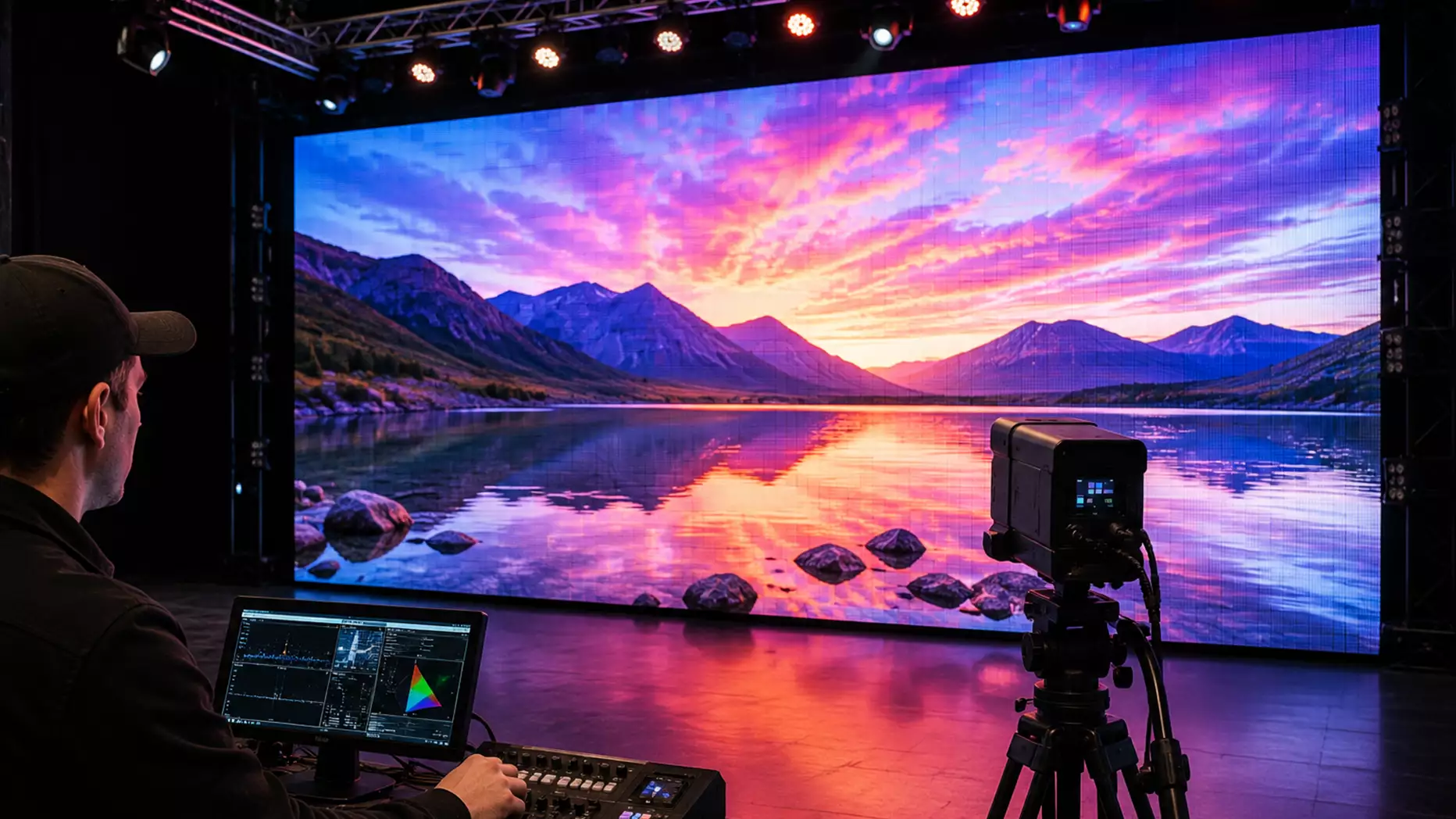
LED wall calibration and colour accuracy describe the process of matching every panel in a rental LED wall to a known standard or brightness, white point, gamma, and colour gamut. For brand events and broadcasts, calibration is what makes corporate colours look right on screen and on camera. For standard slide-driven conferences, it matters less, but it still matters.
A global brand manager flew in for a London product launch and stopped two metres from the LED wall. The visuals were sharp, the room was packed, and the keynote was on time. The problem was the brand’s signature red. On the wall, it rendered closer to orange-red. The deck was right, the file was right, and the panel was bright, but the wall hadn’t been properly calibrated for that brand’s colour. In the broadcast feed, the shift was even more obvious.
That’s the way LED wall calibration and colour accuracy decide whether a brand or broadcast event lands. Most of the time, nothing dramatic breaks. The colour just drifts, the brand looks slightly wrong, and the camera capture exposes it. This post breaks down what calibration actually involves, why multi-panel walls drift in the first place, and when you should insist on it.
What Is LED Wall Calibration And Why Does Colour Accuracy Matter?
LED wall calibration is the process of adjusting every panel and module in the wall so it outputs colour, brightness, and gamma values that match a known standard, typically Rec. 709 for HD broadcast, Rec. 2020 or DCI-P3 for cinematic and HDR work. Colour accuracy is the result: brand colours, skin tones, and product finishes that look the same on the wall, in the camera feed, and in the master file.
Calibration matters for three reasons that show up directly at brand and broadcast events:
- Brand colours have to be right: Corporate brand colours are often Pantone-specific. A wall that drifts even slightly in white point or red primary will render those colours wrong, and brand teams will notice within seconds.
- Multi-panel walls have to look like one wall: A rental LED wall is built from many individual panels, often pulled from different stock batches. Without calibration, you can see panel borders, brightness banding, or pink/green colour patches across the wall.
- Cameras expose everything: Cameras have a narrower dynamic range than the human eye and read colour with less forgiveness. A wall that looks acceptable in the room can look clearly off-spec on the broadcast or livestream feed.
For most standard internal conferences with slide decks and logos, drift is forgivable. For premium brand launches at ExCeL London, award broadcasts from Manchester Central, or any camera-facing build, it isn’t. This is also why we always treat calibration as a technical line item, not a marketing one. It’s part of the same discipline as the technical parameters to check before renting an LED wall.
How Calibration Works On A Rental LED Wall?
Calibration on a rental LED wall happens in two layers: factory calibration on each individual panel, and on-site calibration once the wall is assembled in the venue. Both are needed for top-tier brand and broadcast work. One without the other leaves visible gaps.
The mechanics break down into a few measurable settings:
- White point: The reference white that the wall produces. Most video production workflows use D65 (a specific 6500K white point that matches HD broadcast standards). A wall set to the wrong white point will skew every colour on it.
- Gamma: The curve that maps input signals to output brightness. A wrong gamma curve flattens contrast or crushes shadows, and makes camera-captured footage look unnatural.
- Colour gamut: The range of colours the wall can reproduce, Rec. 709 for HD, Rec. 2020 or DCI-P3 for wider gamuts. The wall has to be calibrated to deliver inside the gamut in which the content was mastered.
- Brightness uniformity: Whether every panel is producing the same peak brightness. LEDs vary from manufacturing (a process called binning) and age at slightly different rates with use, so uniform output is not automatic.
- Colour uniformity: Whether every panel is producing the same colour temperature. This is the setting that, when wrong, makes a wall look patchy or panel-banded.
Modern LED processors handle this. Industry-standard units such as Brompton Tessera and Megapixel HELIOS store per-panel calibration data and apply corrections in real time, so the wall behaves as a single calibrated surface rather than dozens of individual screens. Without a calibration-capable processor in the chain, even factory-calibrated panels can drift visibly once mixed stock is used.
Walls drift for predictable reasons. LEDs lose brightness gradually with hours of use, panels run warmer in the middle of a wall than at the edges, and temperature changes the way LEDs emit light. A wall built from new and older stock without recalibration will show the age difference. None of this is dramatic on its own, but it adds up to a wall that doesn’t quite look right, and a brand team that does notice.
When Calibration Is Non-Negotiable And What To Ask Suppliers
Calibration is non-negotiable for brand launches, award shows, product reveals, broadcast and livestreamed events, and anything camera-facing. It’s strongly recommended for premium internal conferences with brand-heavy content. For a standard regional AGM with slide decks and logos, base factory calibration is usually enough.
Here is how the decision typically breaks down:
| Event Type | Calibration Requirement |
| Broadcast / livestreamed conferences | Full on-site calibration to Rec. 709 (or Rec. 2020 for HDR), with reference monitor checks |
| Brand launches and awards shows | Full on-site calibration plus brand-colour verification before doors open |
| Premium corporate conferences with brand films | Factory calibration plus on-site uniformity check |
| Standard internal conferences and AGMs | Factory calibration is usually sufficient |
| Exhibition stands and retail-style activations | Factory calibration plus a uniformity check, with brand-colour verification if logos are central |
The supplier questions that matter are not complicated. But most quotes don’t volunteer the answers.
Before you sign, ask whether the panels are factory calibrated and how recently, whether on-site calibration is included in the price or extra, which processor is being used and whether it stores per-panel calibration data, and whether the supplier will measure white point and brightness on-site before the event opens. If a supplier can’t answer any of those, the wall is not built for brand or broadcast work yet, and that’s worth knowing before, not after.
This is also where the supplier’s technician earns their place. Calibration is not a button-press; it’s a skill, and good on-site calibration is one of the clearest reasons why skilled technicians matter for LED video wall installations. The processor only does what the operator tells it to do.
If you’re weighing whether to upgrade your visuals with proper calibration in the mix, you can also improve your event visuals with an LED video wall built around brand-accurate colour rather than just raw brightness. The brightness battle is usually already won by modern LED; the colour battle is where premium events differentiate themselves.
Final Word
LED wall calibration and colour accuracy don’t show up on quote sheets the way panel size and pixel pitch do, but they’re often what separates a rental that looks broadcast-ready from one that looks close enough. For brand events, the cost of getting colour wrong is reputational; for broadcast, it’s visible to every viewer. Both are avoidable with the right panels, the right processor, and a technician who knows the standards.
LED Video Wall Hire is a central London supplier, MIA-accredited, with 10+ years of experience and 2,500+ events delivered across UK venues. If your next build is brand or broadcast-facing, talk to us about calibration as part of the spec from day one.
Call 0207 177 4075 or request a quote at ledvideowall-hire.co.uk.
Frequently Asked Questions
1. What does LED wall calibration involve?
LED wall calibration adjusts each panel’s white point, gamma, colour gamut, and brightness uniformity so the whole wall produces accurate, matched output to a known standard such as Rec. 709. It happens at the factory on each panel and on-site once the wall is built. A calibration-capable processor stores per-panel data and applies corrections in real time.
2. How do I know if a rental supplier’s LED walls are properly calibrated?
Ask four questions before you sign: are the panels factory-calibrated and how recently, is on-site calibration included, which processor is in the chain, and will the supplier measure white point and brightness before doors open? Reputable suppliers answer all four directly. Vague answers usually mean calibration isn’t part of the build, and you’ll see the difference on camera.
3. Does calibration matter for a standard conference, or only for brand and broadcast?
It matters most for brand launches, awards shows, and any camera-facing or broadcast event, where off-spec colour reads instantly. For standard internal conferences with slide decks, factory calibration is usually sufficient. The wider the colour content (brand films, product reveals, cinematic footage), the more on-site calibration earns its place in the budget.
