LED wall power depends on screen size, panel model, pixel pitch, brightness, indoor or outdoor use and the supporting AV equipment around it. A proper load calculation should include maximum draw, average draw, installed system power, processors, control gear, power distribution, cable routes and a safety margin. Venues should confirm supply type, circuit capacity, access, load-in timing and cable routes before event day. Outdoor screens and high-profile events often need a generator or UPS backup. A technical site survey helps prevent tripped circuits, voltage drop, delays and underpowered screens.
A tripped circuit fifteen minutes before doors open is not a problem you want to solve in front of an audience. It is one of the most common reasons live events lose their visuals, and it is almost always the result of poor planning that started too late or relied on assumptions about the venue.
Understanding the power requirements for LED video walls is the difference between a screen that performs reliably and one that dims, freezes or fails when the room is full. Power depends on screen size, LED panel model, pixel pitch, brightness setting, indoor or outdoor use, content type and the supporting AV equipment around the screen. A safe plan should calculate panel draw, processors, control gear, installed system power, cable routes, inrush current and backup needs before the venue supply is confirmed.
Whether you are running a product launch in a London hotel, an exhibition stand at ExCeL or Olympia, a conference stage in SE1, or an outdoor screen for a UK cultural event, the supply behind the wall needs as much attention as the content on it. LED Video Wall Hire helps organisers plan this early, with delivery, setup, testing, on-site technical support and collection included.
This guide explains how LED wall power is calculated, what venues need to provide, when backup becomes essential and which mistakes cause avoidable downtime on event day.
What Are The Power Requirements For LED Video Walls?
LED video wall power requirements are the electrical supply needed to run the LED panels, processors, control equipment and related AV safely for the full event schedule.
There is no single wattage that applies to every LED wall. The figure changes based on screen dimensions, total panel quantity, pixel pitch, panel efficiency, brightness level, content brightness and whether the screen is indoors or outdoors.
A simple power chain looks like this:
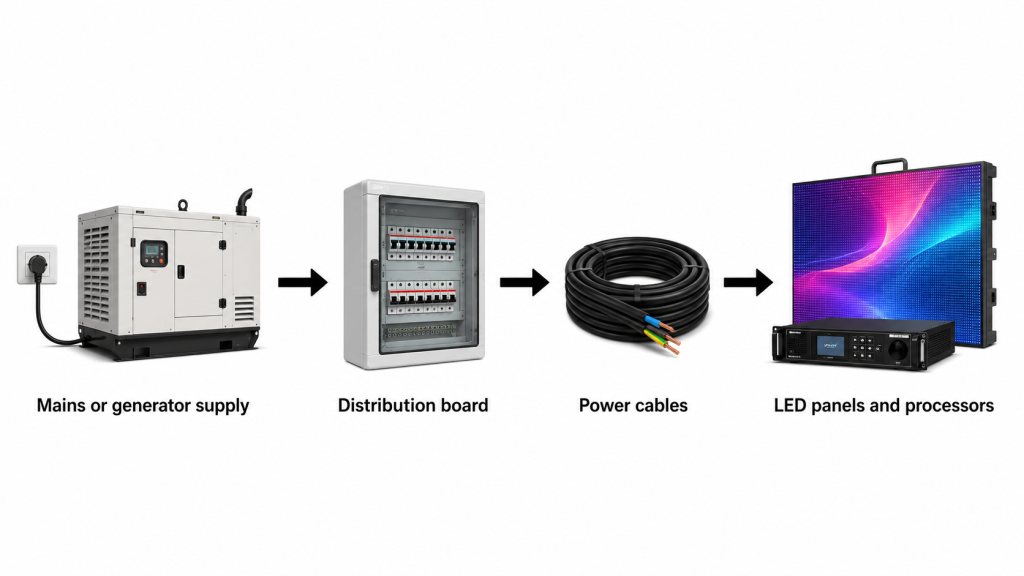
The key variables are:
- Screen dimensions and total LED panel quantity.
- Pixel pitch and panel efficiency.
- Average draw versus maximum draw at peak brightness.
- Indoor or outdoor use and required brightness.
- Processors, media servers and other control equipment.
- Power supplies, distribution equipment and cable run limits.
- Safety margin for peak content, startup load and supporting AV.
Planners should also understand three different power values:
- Maximum power is the highest possible load, usually linked to high brightness or bright full-screen content. It is used for electrical design and power distribution planning.
- Average power is the likely operating load during normal content playback. It is useful for estimating energy use, but it should not be used to size cables, circuits or distribution equipment.
- Installed system power is the practical planning figure. It includes the screen load, processors, power supplies, distribution units, conversion loss, cooling equipment, where relevant, and a safe operating margin.
The correct figure should always come from the specific LED panel data sheet, plus the supplier’s calculation for the rest of the rig.
How Do You Calculate LED Video Wall Power Load?
LED video wall power load is calculated by taking the manufacturer’s data sheet figure, multiplying it by the number of panels or screen area, adding control and AV equipment, then applying a safety margin against the venue supply.
Use this process:
- Confirm the LED panel model being supplied.
- Confirm the number of panels or tiles in the configuration.
- Check the average and maximum power draw on the data sheet.
- Multiply the draw by the number of panels.
- Add processors, media servers, vision mixers and related AV.
- Add system loss, auxiliary equipment and a safety margin.
- Confirm the final figure with the venue or event electrician.
The panel-count formula is:
Total Peak Power = Number Of Panels × Maximum Power Per Panel
Some suppliers calculate by screen area instead. If the data sheet gives maximum watts per square metre, use:
Maximum Screen Power = Screen Area × Maximum Power Per Square Metre
For single-phase UK planning, the current can be estimated as:
Amps = Total Watts ÷ 230V
For venue planning, the more useful figure is:
Installed System Power = Maximum Screen Power + System Loss + Auxiliary Equipment + Safety Margin
This margin should not be guessed. It should be agreed with the LED supplier, venue team or event electrician. It may cover power conversion loss, media servers, fans, control equipment, startup load, inrush current and basic operating headroom.
Illustrative example only: if 100 LED panels were rated at a maximum of 160W each, peak load would be 16,000W, or 16kW. At 230V, that is about 69.6A before safety margin or supporting equipment. This shows why larger LED walls cannot be planned around standard sockets.
Average power can also be used to estimate electricity use for a long exhibition, retail display or multi-day conference:
Energy Consumption (kWh) = Average Power (kW) × Operating Time (Hours)
What Information Should Your LED Supplier Provide?
A capable LED hire supplier should provide a clear technical rider before load-in.
This should include:
- Panel model, quantity and average or maximum wattage.
- Expected total load in kW and amps.
- Required connectors and recommended supply.
- 16A, 32A or 63A supply requirements.
- Single-phase or three-phase power requirement.
- Power distribution plan and cable run limits.
- Maximum number of panels per power run.
- Backup power recommendation where relevant.
- Technician support for setup and show operation.
Before confirming the booking, it also helps to review the wider technical checks before renting an LED wall, especially if the event involves a tight load-in, restricted venue access, unusual screen shape or mixed AV setup.
The supplier should also confirm power-linking limits. Rental LED panels often use PowerCon or similar connectors, and each panel model has manufacturer limits for safe linking. Exceeding those limits can cause overheating, voltage drop or unstable operation.
What Venue Power Does An LED Wall Need?
A venue must provide suitable circuits, safe cable routes, accessible distribution and enough capacity for the wall plus supporting AV. The LED wall should not be placed on circuits shared with catering, lighting or other high-draw venue systems.
A 13A socket may suit a single processor or a very small display, but most professional LED walls need dedicated supplies. UK event work commonly uses CEEform connectors for safe, locked connections:
- 16A single-phase: small screens, control racks and AV inputs
- 32A single-phase or three-phase: medium walls and stage racks
- 63A three-phase: larger walls, full stage rigs and high-power AV setups
Single-phase power is usually suitable for smaller or moderate loads. Three-phase power is used when the load is larger and needs to be shared across three lines. Phase balancing matters because pushing too much load onto one phase can cause breaker trips, unstable equipment and testing delays.
Cable planning should be based on installed system power, not average operating power. The main power cable carries the planned system load from the venue supply, generator or distribution board. Internal screen power cables then distribute that load across different screen sections, helping reduce voltage drop and brightness inconsistency.
Cable length also matters. As distance increases, voltage drop can become more noticeable. If the wall is far from the distribution board or generator, the venue electrician may need to review cable size, route and distribution layout before approving the setup.
For a London hotel ballroom, dedicated stage power may be limited, with circuits sometimes shared with catering or house lighting. Exhibition stands at ExCeL or Olympia normally require power to be ordered in advance through the venue’s official electrical contractor.
The HSE says event organisers and contractors must ensure electrical equipment at events is properly selected, installed and maintained safely.
What Should Be Checked During A Technical Site Survey?
A technical site survey should confirm access, power, cable routes, audience safety and timing before the LED wall arrives.
The site survey should check:
- Access route and load-in timing.
- Power location and distribution board position.
- Cable routes and the need for ramps or matting.
- Generator position for outdoor events.
- Rigging or ground support.
- Weather exposure and audience safety lines.
- Venue restrictions and emergency access.
- Rehearsal schedule and collection plan.
The survey should also check the inrush current and the power-up sequence. Some LED systems draw a short startup surge when first energised. The venue electrician should confirm that protective devices, distribution boards and power-up timing can handle the startup load safely.
Larger systems can also create nuisance tripping if multiple power supplies are placed on unsuitable shared protection. This should be reviewed by the venue electrician when planning RCD protection, circuit separation and distribution.
Rehearsal power also matters. The LED wall may need full power before showtime for testing, sponsor slides, camera checks, live-stream rehearsals and full-brightness content checks.
When Do LED Video Walls Need Backup Power?
LED video walls need backup whenever a screen failure would interrupt the event, disrupt a live stream, affect revenue, damage the brand experience or create a safety concern.
Backup is strongly recommended for:
- Product launches with media or investor audiences.
- Award ceremonies and televised events.
- Conferences with paid delegates and live streaming.
- Sporting events, concerts and outdoor screens.
- Fundraisers, charity events and cultural events.
- Any event where downtime would be visible and costly.
A backup generator provides a secondary supply. A UPS protects processors, media servers and control gear from brief mains drops. Separate feeds can split critical equipment across more than one supply. Spare processors, spare panels, and on-site technical support help keep recovery time short.
A UPS will not usually run a large LED wall for long, but it can stop processors from crashing during a brief power dip. That matters because if the control chain reboots, the wall may stay blank even after power returns.
For critical moments, such as keynotes, headline performances, live broadcasts, or timed sponsor reveals, plan as if something might fail.
Indoor Vs Outdoor LED Wall Power Planning
Outdoor LED screens usually require more electrical planning than indoor walls because brightness, weather protection, generator location and longer cable runs all affect the supply.
If you are still comparing formats, this guide to indoor vs outdoor LED screen hire can help you understand how brightness, weather exposure and venue conditions affect the final setup.
| Planning Factor | Indoor LED Wall | Outdoor LED Screen | What Event Planners Should Check |
| Brightness | Lower because lighting is controlled | Higher for daylight visibility | Daytime visibility, ambient light and content brightness |
| Power supply | Often venue mains | Venue supply, site tie-in or generator | Supply type, capacity and access |
| Weather protection | Controlled indoor conditions | IP-rated panels and covers | Rain plan, wind plan and cable protection |
| Cable routes | Shorter internal routes | Longer external routes | Matting, ramps, trip hazards and vehicle routes |
| Backup power | Event-dependent | Strongly recommended | UPS for processors, generator backup and spare control gear |
| Venue restrictions | Rigging, noise and fire exits | Permits, ground protection and site rules | Council, venue and production restrictions |
| Setup time | Often shorter | Often longer | Load-in, testing and rehearsal window |
| Technical support | Setup plus on-call | Usually on-site throughout | Confirm crewing in writing |
The Purple Guide is an event safety publication used by event professionals and a useful reference for temporary event infrastructure planning.
What Can Go Wrong If Power Planning Is Missed?
Poor power planning causes tripped circuits, unstable panels, reduced brightness, late setup, unsafe cable routes and avoidable stress during the event. Most failures are predictable and avoidable when the power conversation starts early.
Common examples include:
- An exhibition stand orders the smallest power package, and the wall dims as soon as booth lighting kicks in.
- A hotel conference room shares circuits between AV and catering, and the screen drops when the kitchen ramps up at lunch.
- An outdoor screen sits too far from the generator, causing a voltage drop on long cable runs.
- Content runs at peak white during rehearsals on a supply sized for average draw, and the breaker trips before doors open.
- A processor reboots after a brief mains dip because nothing protects the control chain.
- Load-in is delayed because the power location was not checked during planning.
- No technician is available when the fault appears.
Another common mistake is mixing up maximum power, average power and installed system power. Maximum power should guide electrical safety and distribution planning. Average power is mainly for energy estimates. Installed system power is the figure used to plan cable capacity, distribution and protection.
Skipping system loss is also risky. Some calculations stop at the LED screen itself and ignore power supplies, control hardware, cooling equipment and conversion loss. When these are missed, the installed power is underestimated, and the system may run too close to its limit.
Many of these issues are easier to prevent when skilled LED video wall technicians are involved from the planning stage, not just on event day.
How Does LED Video Wall Hire Support Safer Venue Planning?
An experienced LED hire team matches the screen design to the venue power, access arrangements, backup provision and operating schedule before event day, while there is still time to change the plan.
LED Video Wall Hire is based at Unit 2, 221 New Kent Rd, London SE1 4AG, with 10+ years in LED and 25+ years across wider AV. The team has access to an inventory of more than 30,000 pieces of AV equipment and offers same-day dispatch across London, where available.
As an MIA Member and Prestigious Venues Member, LED Video Wall Hire supports corporate clients, hotels, trade show organisers, production companies and event agencies across the UK.
Services include indoor LED video walls, outdoor LED screens, LED backdrops, stage walls, LED floor solutions, 360 LED screen solutions, modular LED screen solutions and full AV packages with 4K laser projectors, PA systems, digital mixers, vision mixers, staging, trussing and live streaming solutions.
Every booking includes delivery, setup, on-site technical support and collection. That means power planning, screen build, testing and support are handled as part of the production, not added as an afterthought.
What Happens After You Request A Quote?
After you request a quote, an LED specialist reviews your event, venue and timing, then builds a screen and power plan that the venue can actually support.
The practical process is:
- Consultation about event type, audience and objectives.
- Venue review covering access, power and restrictions.
- Screen size and pixel pitch recommendation.
- Power and supply check against venue capacity.
- Technical planning, including cable routes and backup.
- Delivery scheduling.
- Setup, testing and on-site support.
- Collection and de-rig.
You should receive a written specification listing the screen, processors, power distribution, cabling, crewing and any backup power recommendation.
The cost of LED video wall hire in London depends on screen size, indoor or outdoor use, pixel pitch, setup complexity, venue access, power distribution, rigging or ground support, delivery distance, operating hours, technician requirement, backup power needs and any wider AV or live streaming package.
A reliable quote should include technical planning, power planning, delivery, setup, testing, on-site support and collection. When reviewing suppliers, check for red flags to compare LED video wall quotes, especially unclear power planning, missing technician support, vague screen specifications or hidden setup costs.
Common LED Wall Power Planning Mistakes To Avoid
The biggest mistake is assuming any plug socket will work. A professional LED wall is not the same as plugging in a display screen.
1. Assuming any plug socket will work
Most LED walls need dedicated 16A, 32A or 63A supplies, not shared sockets.
2. Using average power for electrical design
Average power helps estimate energy use, but it should not size circuits, cables or distribution.
3. Forgetting processors and supporting AV
Control gear, media servers, signal equipment and AV racks all add to the load.
4. Ignoring peak draw
Average wattage leaves no headroom for bright content, peak brightness or startup load.
5. Not confirming venue power early
Available power can change the screen design, layout and quote.
6. Leaving generator planning too late
Outdoor events need time to plan generator size, fuel, positioning and cable routes.
7. Ignoring power-linking limits
Each LED panel model has limits for how many panels can be linked safely on one run.
8. Not allowing power for rehearsals
Rehearsals, testing and sponsor checks often draw the same power as the show.
9. Ignoring cable route safety
Trailing cables across walkways, fire exits, or public routes creates real risk.
10. Not booking on-site technical support
A fault usually takes longer to resolve when no technician is available.
Conclusion
The power requirements for LED video walls need to be assessed early and accurately against the specific panel and venue. Confirm the panel model, load calculation, supply type, cable routes, phase balancing, backup power, rehearsal schedule, cable run limits and technician cover before event day.
The aim is not to find one generic power number. It is to understand which value is used for which decision. Maximum power protects the electrical design. Average power helps estimate energy use. Installed system power helps plan venue supply, cable capacity and distribution.
If you are planning an event in London or anywhere in the UK, talk to LED Video Wall Hire before the venue and screen design are locked in. Call 0207 177 4075, email [email protected] or request a no-obligation quote for screen, power, setup and full on-site technical support.
FAQ
How Much Power Does An LED Video Wall Need?
It depends on the panel model, screen size, brightness, indoor or outdoor use and supporting equipment. A small indoor backdrop may run from a 16A supply, while a large outdoor screen with full AV may need 63A three-phase power plus generator planning. Always size the system against the panel manufacturer’s data sheet.
How Do You Calculate LED Video Wall Power Requirements?
Take the maximum panel wattage from the manufacturer’s data sheet, multiply it by the number of panels, then add processors and other AV equipment. If the data sheet uses watts per square metre, multiply screen area by maximum W/m². Apply a safety margin, then confirm against the venue supply and cable limits.
Can An LED Wall Run From A Normal Plug Socket?
A 13A socket may run a very small wall or a single processor, but most professional LED walls cannot run safely from standard venue sockets. Larger configurations need dedicated 16A, 32A or 63A CEEform supplies with proper distribution. Confirm the supply with your LED hire team before finalising the venue.
Do Outdoor LED Screens Need Generators?
Often, yes. Outdoor screens usually run at higher brightness, use larger configurations and may sit away from venue mains. A generator gives controllable power and avoids drawing on venue circuits not sized for show loads. Many teams use a generator as backup for high-profile outdoor events, even where mains is available.
What Is The Difference Between Average And Maximum LED Wall Power Draw?
Average draw is the typical power used during normal content playback. Maximum draw is what the wall can pull at peak brightness on bright content, plus startup demand. Sizing against average alone is a common cause of tripped breakers because real event content can hit peak draw unexpectedly.
What Is Installed System Power For An LED Wall?
Installed system power is the planning figure used for power distribution, cable capacity and protection. It includes maximum screen power, processors, power supplies, control equipment, system loss, cooling equipment and safety margin, where relevant. It is more useful for venue planning than average operating power.
How Much Does LED Video Wall Hire Cost In London?
Cost depends on screen size, indoor or outdoor use, pixel pitch, setup complexity, venue access, power distribution, rigging, delivery, operating hours, technician requirement, backup and any wider AV package.
What Size LED Screen Do I Need For An Event?
Screen size depends on viewing distance, room dimensions, audience numbers, content type and the role of the screen, such as backdrop, IMAG, brand display or stage centrepiece. Pixel pitch matters as much as physical size because tighter pitches suit closer audiences. A specialist should recommend the screen and pitch from your venue plan.
What Happens After I Request A Quote?
A specialist reviews your event, venue and timing, then prepares a written specification covering screen, power, distribution, cabling, crewing and backup. The proposal usually includes delivery, setup, testing, on-site technical support and collection. From there, you refine the design, confirm dates and arrange a site survey if needed.
Can LED Video Walls Be Used Outdoors In The UK?
Yes. Outdoor-rated LED screens use weather-suitable panels, a secure structure and daylight-suitable brightness. UK use needs planning for wind, rain, ground protection, generator positioning and longer cable runs. Outdoor events are more likely to need backup power and an on-site crew throughout. Confirm rating, structure and weather contingency at the quote stage.
