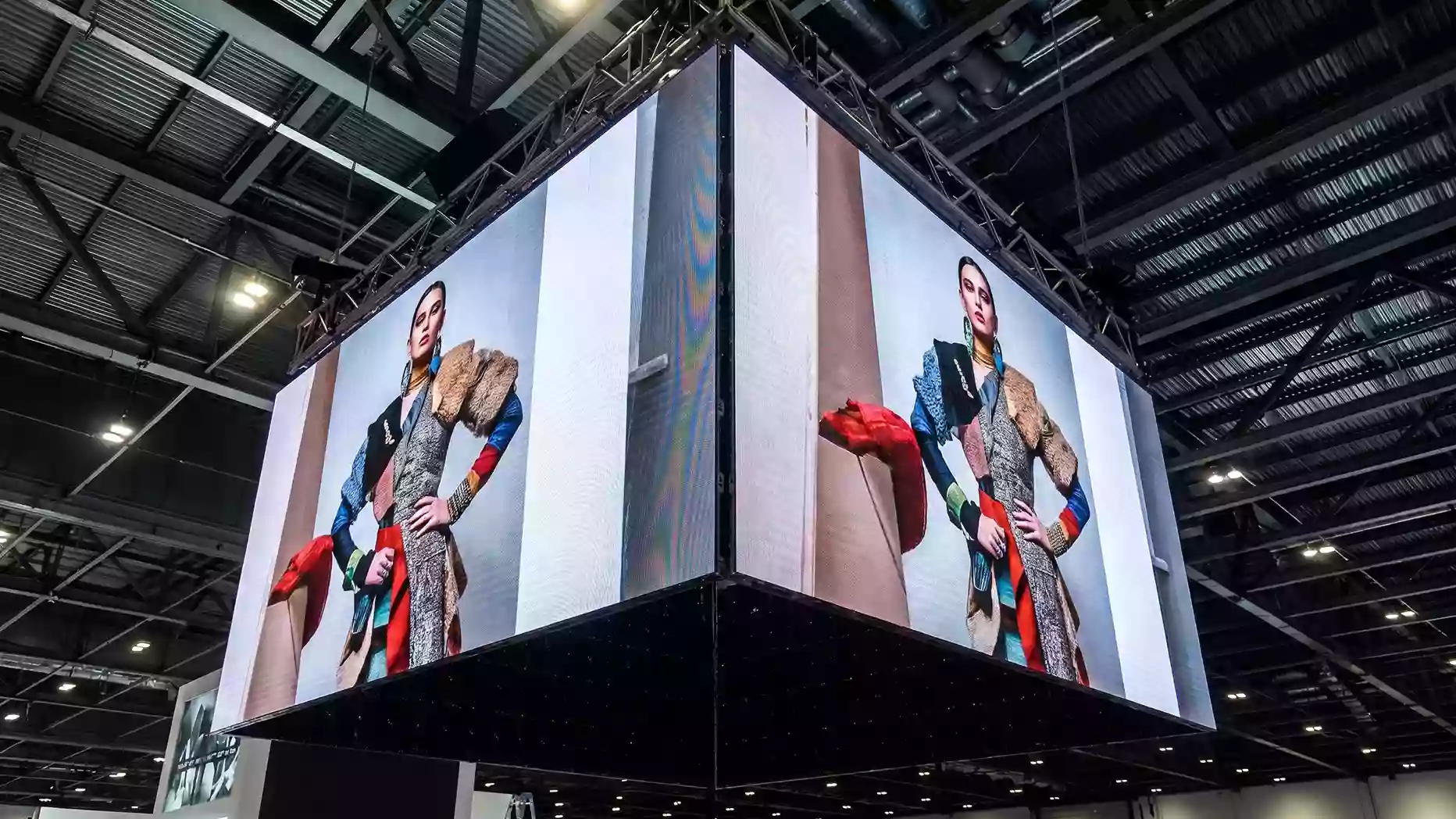
Autumn exhibitions require early LED wall planning. Simple shell schemes may need 4-6 weeks, while larger or rigged walls need 8-16 weeks. Venue manuals set the actual deadlines for power, RAMS, access, rigging, and stand approval.
Book LED wall hire for an autumn exhibition as soon as your stand space and stand type are confirmed. Allow 4-6 weeks for a simple shell scheme screen, 8-12 weeks for a large space-only LED wall, and 12-16 weeks for rigged, outdoor, or complex installations.
The most expensive LED wall at an autumn exhibition is often the one booked too late.
The screen may still be available, but the power order, rigging approval, RAMS deadline, or delivery slot may already be tight. That is why booking LED wall hire for exhibitions should happen before the final stand layout is locked.
Between September and November, ExCeL and Olympia run busy London exhibition calendars while conferences, awards, product launches, and brand activations compete for the same AV crews and LED stock.
This guide explains when to book, what to check in your exhibitor manual, how ExCeL and Olympia differ, and what can still be done if you are working close to build-up.
Why Is Autumn Peak Season For Exhibition LED Wall Hire?
Autumn is peak season because September to November brings a heavy run of trade shows, conferences, and corporate events across London.
That pressure is not limited to show-open dates. It starts during warehouse prep, content testing, vehicle loading, delivery slots, build-up, rigging, show support, breakdown, and collection.
Olympia’s autumn schedule shows how tight the calendar can become. PLASA Show runs from 6-8 September 2026 at Olympia London, and Top Drawer A/W26 runs from 13-15 September 2026 at Olympia London.
For exhibitors, this means the first build-up day matters more than the first visitor day. Your LED supplier needs to know when the stand can be accessed, when power is available, when the wall can be built, and when content must be tested.
- Preferred LED panel stock may already be booked.
- The best installation crew may be committed elsewhere.
- Delivery slots may already be limited.
- Rigging approvals may already be closed.
- Venue services may move into standard or late rates.
- Content may be created in the wrong size.
- Stand drawings may no longer allow safe cable routes.
Autumn rewards early decisions. You do not need every video file ready on day one, but you do need the screen size, support method, power route, and venue process agreed early.
How Far In Advance Should You Book LED Wall Hire For An Exhibition?
Most exhibitors should begin the LED wall hire process 4-16 weeks before the first build-up date.
The exact window depends on what you are building. A simple ground-supported screen on a shell scheme stand can move faster. A large LED wall built into a space-only stand needs more time because it affects stand drawings, electrical plans, flooring, cladding, cable routes, and storage.
Wider exhibition planning guidance supports early preparation. UK exhibition planning timelines commonly work backward from six months, three months, and one month before the show, while exhibition stand planning resources often recommend longer timelines for bespoke stands and integrated technology.
| Exhibition LED wall scenario | Market-based booking window | Why this timing matters | What may still be possible closer to the show |
| Single LED screen on a shell scheme stand | 4-6 weeks | Allows time to confirm stand dimensions, power, access, screen support, and content format | Standard ground-supported screens may still be possible if stock and access are available |
| Small ground-supported LED wall | 6-8 weeks | Gives time for screen sizing, support planning, electrical checks, and content setup | Smaller walls or standard screen formats may remain possible |
| Large LED wall on a space-only stand | 8-12 weeks | The stand builder, AV supplier, and electrical contractor need time to coordinate | Screen size or support method may need to change if the stand is locked |
| Rigged or hanging LED installation | 12-16 weeks | Organiser permission, rigging data, RAMS, and venue review takes time | Ground support may be the fallback if rigging deadlines have passed |
| Outdoor LED screen or entrance activation | 10-14 weeks | Weather protection, permissions, siting, power, and security need review | Smaller outdoor-rated screens may be possible if logistics are simple |
| Multi-show autumn tour | 3-6 months | Equipment, crew, transport, and content must work across several venues | Separate equipment packages may be needed if dates overlap |
| Last-minute LED screen hire under two weeks | Immediate enquiry only | Feasible only when stock, access, power, and crew are simple | Standard ground-supported screens are the most realistic option |
Why Venue Advance Windows Matter
Late booking can increase the total project cost even if the LED wall hire price itself has not changed.
ExCeL’s 2026 event services rate card uses Advance, Standard, and Late rate bands for services such as IT. Its published rate card states that the advance rate applies 28 or more days before the tenancy start date, the standard rate applies up to 14 days before the tenancy, and the late rate applies within seven days, subject to availability.
ExCeL’s Venue Services Centre also states a cancellation policy based on the first day of event tenancy: 100% refund or credit at 28 days or more, 50% at 27-8 days, and no refund within seven days.
For rigging, ExCeL’s rigging guidance says exhibitors must confirm orders 28 days before the start of event tenancy to benefit from the advance order rate. It also says exhibitors should have permission to rig from the event organiser before requesting a quote.
That does not mean 28 days is enough for every LED wall. It means certain venue services should already be confirmed by then. For large or rigged LED walls, planning should start earlier.
What Do Show Organisers And Exhibitor Manuals Require?
The exhibitor manual is the primary document that controls your stand requirements.
Your LED supplier can advise on screen size, support, power, and content setup, but the organiser and venue control the final approval process.
Send the complete manual to your supplier as soon as you receive it. Do not send only one page or a screenshot. LED wall requirements are usually spread across several sections.
- Hall and stand number.
- Stand type.
- Stand dimensions.
- Build-up and breakdown dates.
- Contractor access times.
- Shell scheme restrictions.
- Space-only stand approval rules.
- Height limits.
- Rigging process.
- RAMS deadline.
- Electrical order forms.
- Internet and data options.
- Loading bay instructions.
- Contractor passes.
- Floor protection rules.
- Dilapidation notes.
At ExCeL, the event services rate card states that cabled services are supplied through floor ducts and asks exhibitors to provide marked plans showing preferred service locations. It also asks that no unauthorised wireless routers are used because they may interfere with the venue network. This matters because an LED wall is not just a display surface. It needs power, signal, processing, access, support, and testing.
Do I Order Power From The Venue Or Does The LED Supplier Provide It?
The LED supplier should calculate the likely power requirement, but the venue or appointed electrical contractor normally provides the exhibition mains supply.
Do not assume a standard stand socket is enough. The power order should be based on the actual LED wall, processors, playback devices, and any supporting AV equipment.
If your stand also needs sound, switching, staging, or live streaming, discuss the full technical load at the same time. A supplier that handles AV equipment hire in London can assess the stand as one working AV system, not separate pieces of kit.
Can You Use An LED Wall On A Shell Scheme Stand?
Yes, but the LED wall must fit within the shell scheme dimensions and should not rely on shell panels for support unless the organiser has approved it.
A shell scheme usually includes standard wall panels, fascia, and fixed dimensions. A compact, ground-supported LED wall is often the safest route.
- Usable wall width.
- Usable stand height.
- Open sides.
- Power position.
- Counter and furniture layout.
- Visitor flow.
- Viewing distance.
- Content format.
A shell scheme screen works best when the content is bold, simple, and readable from the aisle.
Can You Use A Large LED Wall On A Space-Only Stand?
Yes. A space-only stand is usually the best option for a large LED backdrop, product demo wall, stage wall, or custom screen shape.
It also needs more planning. The LED wall should be coordinated with the stand builder before final drawings are approved.
- Final stand drawings.
- Screen opening size.
- Ground support or rigging.
- Cable routes.
- Processor location.
- Power distribution.
- Load-in route.
- Build sequence.
- Rear access.
- Show-day operating position.
If the LED wall is added after the stand design is locked, the supplier may need to reduce the wall size or change the support method.
Booking LED Wall Hire For Exhibitions At ExCeL London
For ExCeL London, plan around scale, venue services, power routes, delivery access, and rigging approval.
ExCeL is a large exhibition venue located in the Royal Docks. Its scale works well for major brand stands and large LED displays, but it also means delivery and build-up need to be planned properly.
- Event name.
- Hall and stand number.
- First tenancy date.
- Build-up access period.
- Show dates.
- Breakdown time.
- Stand type.
- Stand drawings.
- Proposed LED wall size.
- Ground support or rigging preference.
- Content sources.
- Power information.
- Technician requirement.
How Does ExCeL Rigging Affect LED Wall Planning?
ExCeL’s rigging guidance states that exhibitors need organiser permission before requesting a rigging quote. It also says rigging orders should be confirmed 28 days before tenancy to access the advance order rate.
- Decide whether the wall needs to be rigged.
- Check whether rigging is allowed for the show.
- Share the stand drawings with your LED supplier.
- Confirm load, size, access, and content requirements.
- Submit the required technical information.
- Order venue services before the relevant deadline.
- Coordinate installation with the stand builder.
If the rigging deadline has passed, a suspended LED wall may have to become ground-supported. That can affect storage, sightlines, product display space, and visitor flow.
Practical ExCeL Scenario
A technology exhibitor at ExCeL wants a 6-metre LED wall as the main backdrop for product demos.
If the wall is ground-supported, the stand needs enough depth for support, cable routes, and safe access. If the wall is rigged, organiser permission and venue planning must start earlier.
The question is not only whether a 6-metre screen is available. The real question is whether the stand design, power order, delivery slot, and installation route all support that screen.
That is why exhibitors looking for London LED video wall-hire specialists should involve the supplier before final stand approval.
Booking LED Wall Hire For Exhibitions At Olympia London
For Olympia London, plan around the hall, access route, current exhibitor guidance, rigging route, and stand build sequence.
Olympia’s exhibitor guidance advises exhibitors to plan logistics and parking in advance, research wired and dedicated Wi-Fi options, and coordinate rigging with Outback Rigging Group.
Olympia’s loading and unloading page states that vehicles servicing an event must pre-book through Voyage Control, the maximum vehicle height on site is 4.4 metres, bookings are normally available 30 days before the event start date, and exhibitors should refer to their manuals for more detailed information.
Olympia’s rigging page says exhibitors should plan their requirements with its service partner, Outback Rigging.
Practical Olympia Scenario
A retail brand preparing for Top Drawer A/W26 wants an LED wall behind a product demonstration counter.
Before confirming the screen, the exhibitor should check:
- Which hall is being used?
- Whether the stand is shell scheme or space-only.
- The current delivery process.
- Whether rigging is allowed.
- Where the power can be supplied.
- Whether the content is a looped video or live demo material.
- Screen protection during build-up.
- Whether an on-site technician is needed.
Olympia can be a strong venue for visual product storytelling, but the screen must be designed around the actual hall, stand layout, access route, and show manual.
ExCeL Vs Olympia: What Changes For Your LED Wall?
Both venues can support high-impact LED wall displays, but exhibitors should plan them differently.
| Planning factor | ExCeL London | Olympia London | What exhibitors should check |
| Location | Royal Docks, East London | Kensington, West London | Delivery route, travel time, and contractor access |
| Venue style | Large purpose-built exhibition campus | Historic exhibition venue with hall-specific logistics | Hall layout, access notes, and current exhibitor manual |
| Rigging route | Organiser permission before requesting a rigging quote | Rigging planned with Outback Rigging Group | Submission deadline, drawings, load data, and approval route |
| Power route | Ordered through the event or venue service process | Follow organiser and venue supplier process | Supply size, floor plan, build-up power, and live power |
| Logistics pressure | Large multi-show build periods can create delivery congestion | Vehicle booking and access rules must be checked early | Voyage Control, unloading slot, and vehicle height |
| Best time to confirm LED | Before the venue service and stand approval deadlines close | Before logistics, access, and rigging deadlines close | Earliest deadline in the exhibitor manual |
This table is a planning guide, not a substitute for the exhibitor manual. Rules can change by organiser, hall, show, and year.
Choosing The Right LED Wall For Your Exhibition Stand
Choose the wall from the stand dimensions, viewing distance, content, and support method.
Bigger is not always better. A huge LED wall on a shallow stand can be hard to read if visitors are too close. A smaller wall with sharp, simple content can perform better if it sits in the right sightline.
- Screen width and height.
- Pixel pitch.
- Viewing distance.
- Stand depth.
- Ground support or rigging.
- Content resolution.
- Ambient light.
- Live feed or looped playback.
- Processor position.
- Technician access.
This article does not repeat the full-screen-type comparison. For that, use the guide to LED walls vs LED screens for exhibition booths.
If the stand needs a lighter retail-style look, transparent LED screens for exhibition stands may be worth reviewing. If you want wider creative direction, the article on trade show display trends with LED video walls gives more design-led context.
How Does Pixel Pitch Affect Booking?
Pixel pitch affects viewing distance, image detail, screen choice, and cost.
A close-viewing exhibition stand usually needs a finer pitch than a screen viewed from across a hall. But do not choose pitch from a generic formula alone. Content detail, visitor distance, budget, wall size, and available stock all matter.
A wall showing large brand graphics and short headlines does not need the same specification as a wall showing fine product text, software screens, or live camera feeds.
The supplier should advise after seeing the stand dimensions, content plan, and expected viewing distance.
What Happens During Build-Up, Installation, And Testing?
A professional LED wall installation follows a planned sequence from delivery through to show-open handover.
- Delivery slot confirmation: The vehicle follows the approved access route, hall instructions, and unloading time.
- Equipment check: Panels, processors, supports, cabling, and backup items are checked against the job list.
- Ground support or rigging setup: The support structure is positioned, or the approved rigging process is followed.
- LED panel installation: Cabinets are assembled, aligned, and secured.
- Power connection: The system connects to the ordered and tested supply.
- Signal setup: Playback devices, processors, switchers, and live sources are configured.
- Content loading: Media files are checked against the final screen size and pixel canvas.
- Testing: Brightness, colour, playback, source switching, and backup content are tested.
- Show handover: The exhibitor receives operating guidance, or the technician remains in control.
- Breakdown and collection: Equipment is removed within the approved load-out window.
The AEV eGuide provides guidance on health, safety, operational planning, and on-site conduct across UK event venues. For exhibitors, this means RAMS, safe access, cable management, structural planning, and competent installation should be treated as part of the booking process.
What Can Same-Day Dispatch Solve?
Same-day dispatch can help with urgent equipment needs, but it cannot fix every missed deadline.
- A panel fails.
- A processor needs replacing.
- A cable or playback device is missing.
- A standard screen is needed quickly.
- Extra AV equipment is required during build-up.
It cannot reopen a closed rigging approval, create unavailable power, override venue access rules, or guarantee a vehicle slot when the loading schedule is full.
A London SE1-based LED Video Wall Hire team can support faster response times across ExCeL, Olympia, and central London venues. It should be treated as operational support, not a reason to leave the booking late.
What Happens After You Request A Quote?
A proper exhibition LED wall quote starts with technical discovery, not a square-metre price.
- Consultation: Share the venue, show name, stand number, dates, and initial idea.
- Manual review: The supplier checks the exhibitor manual, access notes, and technical requirements.
- Stand plan review: Screen size, structure, cable routes, visitor flow, and power location are checked.
- Screen recommendation: A suitable LED wall size, pixel pitch, and format are proposed.
- Power and support check: The likely electrical and processing requirements are identified.
- Content planning: The correct file size, canvas, playback method, and deadline are confirmed.
- Venue documentation: RAMS, technical details, and rigging information are prepared where needed.
- Delivery scheduling: Load-in and installation are aligned with the stand builder and venue access.
- Install and testing: The wall is installed, configured, and tested before the show opens.
- Show support and collection: A technician supports the event where included, then the equipment is removed during the breakdown period.
A complete quote should include screen dimensions, panel type, processing equipment, playback requirements, support structure, delivery, setup, testing, technician time, collection, venue-service assumptions, exclusions, and cancellation terms.
Do not judge quotes only by the first price. A cheaper quote that excludes setup, support, testing, or collection may cost more once the show is closed.
Book The Screen While Choices Still Exist
Autumn rewards exhibitors who treat LED wall hire as part of the stand design, not a late display order.
Confirm the stand. Open the manual. Work back from the earliest deadline. Then lock the screen while you still have options for size, support method, delivery slot, and technician cover.
LED Video Wall Hire provides LED screen hire, AV equipment, delivery, setup, testing, technical support, and collection for exhibitions across London and the UK. For a no-obligation quote, call 0207 177 4075 or email [email protected] before your exhibitor manual deadlines close.
FAQs
How Far In Advance Should I Book LED Wall Hire For An Exhibition At ExCeL Or Olympia?
Book 4-6 weeks ahead for a simple shell scheme screen, 8-12 weeks ahead for a large space-only wall, and 12-16 weeks ahead for rigged or complex installations. Multi-show autumn tours should be planned several months ahead because equipment, transport, and crew schedules need to work across every venue.
How Much Does LED Wall Hire Cost For An Exhibition Stand?
LED wall hire cost depends on screen size, panel quantity, pixel pitch, hire duration, ground support or rigging, delivery access, installation labour, technician cover, and content needs. Venue services such as power, rigging, and internet are usually separate, so ask for an itemised quote.
What Does My LED Supplier Need From The Exhibitor Manual?
Your supplier needs the technical timetable, stand rules, power ordering process, rigging guidance, RAMS deadline, loading instructions, contractor access rules, and build-up schedule. Send the full manual because LED wall requirements often sit across several sections.
What Size LED Wall Fits A Shell Scheme Stand?
The right size depends on usable wall width, height, viewing distance, furniture layout, and open sides. A compact, independently supported LED wall is often safer than fixing weight to shell panels unless the organiser has approved that method.
What Size LED Wall Works On A Space-Only Stand?
A space-only stand can support a larger or more custom LED wall, but it must be designed with the stand builder. Confirm structure, support, power, cladding, storage, maintenance access, and cable routes before final drawings are submitted.
Is Last-Minute LED Wall Hire Possible In London?
Yes, but only when stock, crew, power, access, and organiser approval are straightforward. A standard ground-supported screen is more likely to be possible at short notice than a suspended, outdoor, or custom-shaped LED installation.
Can I Book The Same LED Wall For Several Autumn Shows?
Yes, if the show dates, build-up periods, breakdown times, and transport plan work together. Multi-show planning should begin several months ahead because one delay can affect the full tour schedule.
Do ExCeL And Olympia Have Different Rules For LED Walls?
Yes. ExCeL and Olympia differ in hall layouts, service ordering, access, loading, and rigging routes. The organiser’s current exhibitor manual is the final source for your show, even if you have exhibited at the venue before.
Do I Need An On-Site Technician?
Book an on-site technician if the wall supports live demos, camera feeds, presentations, multiple content sources, or high-profile brand activity. A simple looping video may need less support, but every setup should still include testing and a clear fault-response plan
