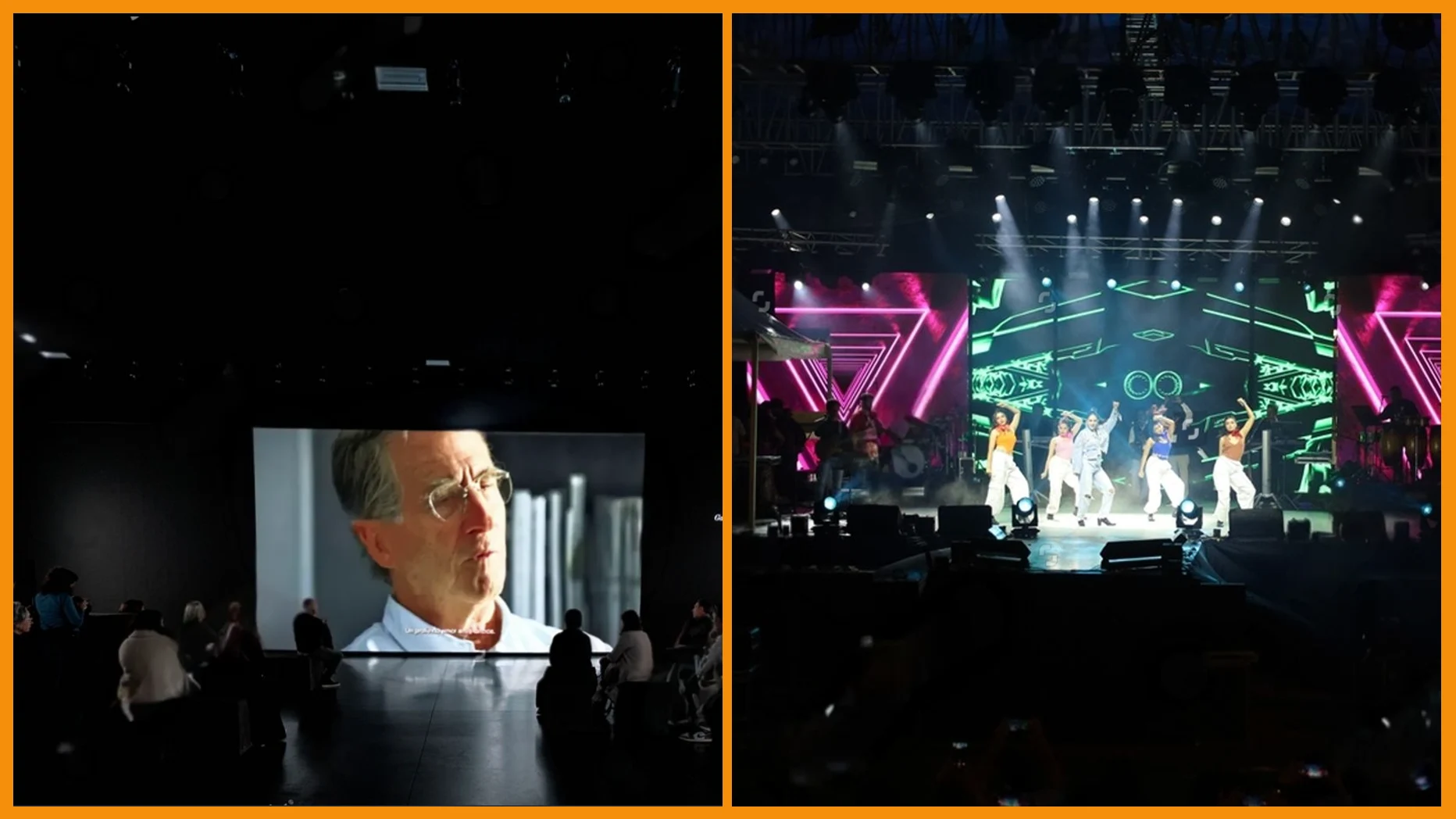
There is a quiet change happening in event rooms and broadcast studios. It looks like a simple swap, a projector screen out, an LED video wall in. But it keeps spreading, because it solves problems that planners have lived with for years: dull visuals, weak sightlines, and content that never looks the same twice.
The numbers back it up. One major research firm put the LED modular display market at $5.7 billion in 2023, rising to $17.84 billion by 2030. Another report estimates the wider LED display market at about $20.73 billion in 2026, heading toward $26.98 billion by 2031.
So yes, LED walls look good. But that is not the full story. They have taken on new jobs in live events, hybrid event technology, and virtual event displays.
How Do LED Video Walls Work as Stage Backdrops?
LED video walls make the stage look intentional because the background can change on cue and stay bright in real venues. They turn the LED stage backdrop into part of the show, not a static wall.
A stage backdrop used to be a printed panel, drape, or projection. Those can look fine until the lighting changes or the camera angle shifts. A direct-view LED wall for events stays punchy, even when the room has strong front light and moving effects. That “it still looks good” quality is why planners keep choosing it.
The other reason is control. When the backdrop is an LED video wall, it can match the moment. Calm gradient for the opening. Branded frame for the keynote. Fast cut visuals for the awards sting. It is one surface, but it can behave like ten different sets.
How do LED Screens Help Presentations and Keynote Speakers Stand Out?
Event LED screens make slides, video, and speaker support content easier to see from every seat. They also make the speaker feel framed, so the room pays attention.
In a conference, the job is simple: get the message across. Conference LED screens do that by being bright, sharp, and readable at scale. When the screen is clear, people stop squinting and start listening.
An LED video wall also helps with pacing. A keynote is not just a person talking. It is a rhythm of points, proof, and pauses. With a solid LED wall for events behind them, you can place a key line on screen, show a short clip, then go back to a clean backdrop. It keeps the room with the speaker, instead of letting attention drift.
What Role Do LED Walls Play in Hybrid Event Technology?
LED walls help a hybrid event feel like one event, because they connect the in-room stage to the remote audience. They give you a visual bridge between live presence and online viewing.
Hybrid event technology works best when nobody feels like a second-class guest. In the room, people want energy and clarity. Online, people want a close-up story and context. An LED video wall helps with both.
On stage, you can bring remote speakers “into the room” at human scale, not as a tiny face on a laptop feed. You can also show live polls, remote questions, and social content without breaking the flow. It is not just decoration. It is a tool for making two audiences share one moment.
How Do LED Walls Support Virtual Event Displays in Studios?
LED walls make virtual event displays feel more real because the host is standing in a controlled scene, not in front of a flat green screen. That usually improves colour, depth, and camera results.
A lot of virtual events are now held in small studios. The presenter might be on a set that looks like a newsroom, a product lab, or a branded world. This is where LED video walls quietly shine.
With an LED wall, you can place the host inside the content. The background can move, shift, and react. It can show a window to remote guests, data, and product visuals. And because it is a real light source in the space, it often looks more natural than a keyed background. It also reduces the risk of a messy edge around hair, hands, and props.
How Do LED Screens Help With Live Streaming and Broadcast?
LED screens help broadcast because they give cameras a clean, bright source image that holds up under close-up shots. They also let producers build scenes that work for both the room and the stream.
When you are streaming, you are not just designing for seats. You are designing for lenses. That is a different game. Cameras love consistency. They hate dull projection, uneven colour, and washed-out blacks.
An LED video wall can be tuned for a camera. It can carry a framed layout for lower thirds, remote guest windows, and branded stings. It also helps when a show has to switch fast between speakers, video, and live inputs. The wall becomes a reliable “canvas” for the director, not a screen you hope will behave.
How do LED Video Walls Improve Brand Visibility and Sponsorship?
LED video walls improve brand visibility because sponsor content can be placed in high-focus areas and changed by time slot. That makes sponsorship feel active, not like a forgotten banner in the corner.
Sponsors pay for attention. LED walls give you more control over where that attention goes. BizBash noted that planners can rotate sponsor exposure during different parts of the day and even use screens for dynamic signage and wayfinding.
This matters because it turns sponsorship into something you can plan and measure. If a sponsor has the keynote slot, you can give them the stage frame, the holding slide, and the break loop. If another sponsor owns lunch, they can own the content loop while people are moving. That is a better story than “your logo was on a roll-up”.
How Do LED Walls Create Immersive Audience Experiences?
LED walls create immersion by filling the viewer’s field of vision with moving content that matches sound, light, and timing. They can make a room feel bigger, deeper, and more alive.
Immersion is not about “more pixels”. It is about being pulled into the moment. A wide LED stage backdrop can turn a plain room into a brand world, a skyline, a gallery, or a shifting abstract space.
This is why event designers keep leaning on LED walls for events in openings, walk-ons, awards, and entertainment beats. You can build anticipation with motion and scale, then snap back to calm when you need focus. It is control of mood, on demand.
How Do LED Video Walls Handle Data Visualisation and Real-Time Updates?
LED video walls make data easier to follow because charts and live numbers can be displayed large, clear, and updated instantly. They are well-suited to dashboards, live results, and real-time schedule changes.
Some events live on data. Sales kick-offs. Investor days. Award shows. Sports-style leaderboards. Even exhibitions with live product demos. The problem is that data is only useful if people can read it.
An LED video wall can carry clean layouts for numbers, maps, and progress bars. It can also update fast, which helps when there is live voting, live Q&A, or a running order change. And because the wall is part of the stage, the updates feel integrated, not like an awkward add-on.
Why are LED Screens Useful for Product Launches?
LED screens help product launches because they can show detail, scale, and story at the same time. They make the “reveal” feel like a moment, not just a slide change.
A product launch has one job: make people care. The LED video wall is often the tool that turns features into feelings. You can show texture, motion, and close-up detail that would vanish on a dim projection.
It also helps with staging. You can build suspense with shadow and silhouette, then hit a bright reveal. You can place the product in a world that matches the brand, without building a physical set that costs a fortune and takes days to change.
What Role Do LED Walls Play in Concerts and Entertainment Events?
LED walls drive concerts because they can act as scenery, lighting, and storytelling all at once. They support big visuals that stay readable even in complex lighting.
In entertainment, LED video walls are not “screens” in the conference sense. They are part of the show language. They can become a moving set, a pulse that matches the beat, or a visual narrative behind the performer.
There is also a practical side. LED walls are not as affected by ambient light, which is useful when lighting designers want freedom without washing out the background. This is one reason they keep showing up in big shows and touring rigs.
How Do LED Displays Help Exhibitions and Trade Shows?
LED displays help exhibitions because they stop people, and they can explain more in less time. They pull attention in noisy halls where every stand is competing.
Trade shows are brutal. You have seconds to win a glance. A bright LED wall for events gives you that first hook. Then it gives you the second job, which is clarity. Product videos, proof points, customer stories, live demos, and timed messages can all rotate without printing and reprinting.
It also helps with flexibility. One day, you might need a bold brand loop. The next day, you might need a schedule, a demo feed, and a lead capture message. An LED screen hire setup can do that without rebuilding the stand.
Are LED Video Walls Replacing Traditional Projectors?
In many venues, yes, LED video walls are replacing projectors because they stay bright, high-contrast, and consistent in real room light. Projection still has a place, but LED has become the safer choice when conditions are not perfect.
AVIXA’s own writing on projection vs LED talks about LED’s sharp, high-contrast visuals that hold up in brighter environments. That is the daily pain point with projectors. You can project look great, but it often needs light control, careful alignment, and the right surface.
Direct-view LED also brings practical wins: seamless visuals, high brightness, and vivid colour, which is why it keeps growing in corporate and event use. If the event is high-stakes and the lighting will not be “cinema dark”, LED walls usually reduce risk.
How Do LED Walls Improve Engagement And Visual Storytelling?
LED walls improve engagement because they help people follow the story with their eyes, not just their ears. They make the content feel like part of the experience, which keeps attention longer.
Engagement is a soft word, but the effect is real. When the stage looks alive, and the visuals support the point, people stay with you. They look up. They take photos. They remember the line because they remember the frame around it.
This is the biggest role LED video walls now play. Not just showing content, but carrying the emotional tone. Calm, urgent, celebratory, serious, playful. The wall can help you move through those shifts without resetting the whole room.
Final Thoughts
LED video walls have moved beyond “nice screens”. They now act as sets, signage, story tools, broadcast surfaces, sponsor platforms, and bridges between live rooms and virtual audiences. The growth in LED display tech and the ongoing rise of virtual events both point to the same truth: events are now built for eyes and cameras at the same time.
When an LED wall for events is planned well, it does not just look good. It makes the event easier to run, easier to watch, and easier to remember.
If you’re planning an event in Greenwich and want screens that look sharp in the room and on camera, LED Video Wall Hire is a strong option for rental LED screens for conferences and events in Greenwich, London.
Contact our team to discuss conference LED screens, stage LED backdrops, exhibition displays, and indoor and outdoor LED wall hire, with full support from planning to show day.
