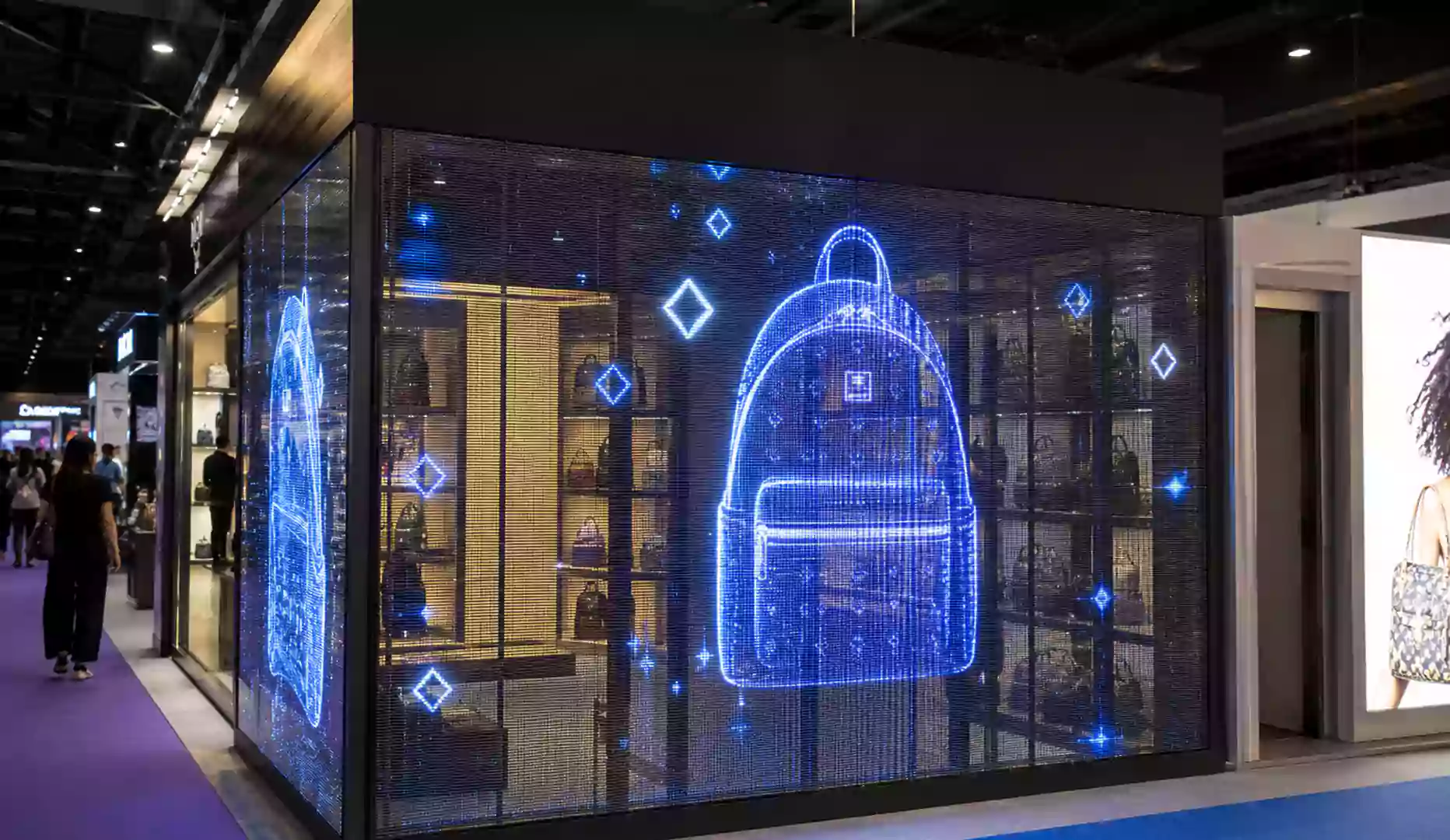
Transparent LED screens for exhibition stands are see-through display panels that show bright digital content while letting visitors see products and activity behind the screen. They add motion and branding without blocking sightlines, replacing static backlit graphics with editable visuals.
Exhibition stands and retail windows have a long-running design problem: how do you grab attention without hiding the product? For years, the answer was static backlit graphics or solid LED video walls, both of which block what’s behind them. Transparent LED screens for exhibition stands now offer a third option, and over the past two to three years, they’ve moved from novelty installations into mainstream stand design at venues like ExCeL London and Olympia London.
This guide explains how the technology works, where it fits, how it compares to backlit graphics, and what to plan for in 2026.
What Is a Transparent LED Screen?
A transparent LED screen is a display made of LED strips on a clear frame. The strips are spaced apart. This lets about 60 to 90 percent of light pass through. It can still show video. The transparency comes from the gaps between LEDs; there is no solid backing panel.
From the front, the LED content appears to float in mid-air. Most current panels are modular, connecting to form custom shapes from small window panels to full-height stand walls.
How Do Transparent LED Screens Work?
LED diodes are mounted onto narrow strips arranged in a grid, with empty space between each row. Each LED produces its own light, so no backlight is needed.
Transparency depends on pixel pitch, the distance between LEDs. A larger pitch means more space between diodes, so more light passes through, but image resolution drops at close viewing distances. A smaller pitch gives sharper images but reduces transparency. This trade-off is the most important specification to get right for your use case.
Brightness matters too. Indoor transparent panels typically output between 1,000 and 4,500 nits, with shop-window models pushing higher to compete with daylight.
Where Transparent LED Screens Work Best in Retail
Transparent LED works best in retail window displays, in-store product features, and architectural glass, where preserving visibility is part of the design.
For flagship stores on streets like Oxford Street, London, transparent screens run motion content on the window itself, while shoppers still see merchandise behind the glass. Static window vinyl graphics have to be reprinted for each campaign; a transparent screen updates from a content management system.
Inside stores, transparent panels are used around product plinths so customers see the physical product through the screen with animated graphics, specs, or branding overlaid. This is common for premium electronics, watches, and automotive showrooms.
Where Transparent LED Screens Work Best on Exhibition Stands
On exhibition stands, transparent LED works best as feature walls, hanging reveals, and glass-fronted product displays where designers want digital impact without losing sightlines.As part of the broader shift in trade show display trends with LED video walls, transparent panels have become one of the most talked-about formats among stand designers working on larger footprints.
A transparent panel at the front of a stand draws attention from across the hall while still letting visitors see activity inside, solving a common problem with solid LED walls, which can make stands look closed off and reduce footfall.
Suspended transparent panels also create overhead branding visible from multiple aisles. At venues like ExCeL London, Olympia London, and Manchester Central, ceiling height usually allows this.
For product launches, a transparent screen in front of the product runs animated content showing key features, specifications, and brand storytelling, while the product itself stays visible.
Transparent LED vs Traditional Backlit Graphics
Transparent LED is not always the right answer. Backlit graphics remain cheaper, simpler, and better for static brand messaging.
| Factor | Transparent LED | Backlit Graphics |
| Content type | Motion video, animation | Static images and text |
| Update flexibility | Edited in minutes | Requires reprint |
| Cost | Higher hire cost | Lower cost per square metre |
| Visibility behind | 60–90% light transmission | None, opaque |
| Best for | Multi-day shows, rotating campaigns | Single-message stands |
For a one-day stand with a single message, backlit graphics often make more financial sense. For multi-day exhibitions with rotating content or retail campaigns that change weekly, transparent LED earns its cost. Understanding the wider advantages of LED video walls at trade fairs in the UK, a transparent or standard LED format better suits your objectives and budget as well.
Need Help Planning a Transparent LED Installation?
If you’re weighing transparent LED against other options, talking through content, sightlines, ambient light, and viewing distance early saves time and budget later. Some London-based hire companies, including LED Video Wall Hire, offer pre-event consultations to work through these factors before any equipment is booked.
What to Consider Before Choosing Transparent LED
Real-world performance depends on planning factors that get overlooked in showroom demos.
- Pixel pitch vs viewing distance
A modest transparent wall on a pre-built stand typically takes a qualified team a few hours to install, including content testing. Retail windows need a tighter pitch, which reduces transparency.
- Content design
Light backgrounds and fine detail disappear. Effective content uses dark backgrounds, bold motion, and high contrast. Reusing existing brand video usually doesn’t work without redesign.
- Ambient light
Specify panel brightness against the actual install environment, not the showroom.
- Power and cabling
Cable routing through open stand structures needs planning at the design stage, not on build-up day.
- Rigging
Most major UK exhibition venues require rigging plans submitted in advance.
Final Thoughts
Transparent LED screens earn their place when sightlines matter, when content needs to update, and when a brand needs digital impact without closing off the space behind. For static, single-message stands or short retail campaigns, backlit graphics still hold up.
The best results come from planning early, with pixel pitch matched to viewing distance, content designed for transparency, brightness specified for the actual environment, and rigging confirmed against venue rules.
If you’re planning a stand at ExCeL London, Olympia London, or a retail installation in Central London, LED Video Wall-Hire offers advice on screen suitability, sizing, and logistics. Call us at 0207 177 4075 to talk through specifics.
FAQs
How Much Does Transparent LED Screen Hire Cost in the UK?
Transparent LED hire costs more per square metre than standard indoor LED video wall hire because of the specialist panels and higher technical setup involved. Final pricing depends on screen size, pixel pitch, hire duration, delivery, installation, and on-site technical support. For a realistic figure, request a quote with your stand or window dimensions, event dates, and venue details.
Can Transparent LED Screens Be Used Outdoors?
Some transparent LED screens are rated for outdoor use, with higher brightness and weather-resistant builds, but most transparent panels on the UK hire market are indoor-rated. For outdoor retail facades or external stand features, confirm the IP rating and brightness with the supplier. For most outdoor applications, traditional outdoor LED screens are still more practical and cost-effective.
Are Transparent LED Screens Better Than Projection?
Neither is universally better. Transparent LED produces brighter, sharper images and works well in well-lit environments where projection would wash out. Projection is cheaper for very large surfaces and irregular shapes. For exhibition stands and retail windows with ambient light, transparent LED is generally more reliable. For dark venues, projection may still be the better choice.
How Long Does It Take to Install a Transparent LED Screen?
A modest transparent wall on a pre-built stand typically takes a few hours for a qualified team, including content testing. Larger or suspended installations with rigging take longer and need to fit into the venue’s build-up schedule. Always factor in content programming and a full pre-show rehearsal.
Do Transparent LED Screens Need Special Content?
Yes. Content designed for standard screens often performs poorly because light backgrounds and fine detail get lost. Effective transparent LED content uses dark or black backgrounds, high-contrast graphics, bold typography, and strong motion. Allow time and budget for content design; reusing a standard brand video without changes usually delivers a disappointing result.
What Pixel Pitch Should I Choose?
Pixel pitch should match viewing distance. Closer viewing, like a retail window where shoppers stand a metre away, needs a tighter pitch (lower number) for sharp images. Wider viewing distances on exhibition stands tolerate a larger pitch, which also gives better transparency. Confirm the expected viewing distance before specifying a panel.
