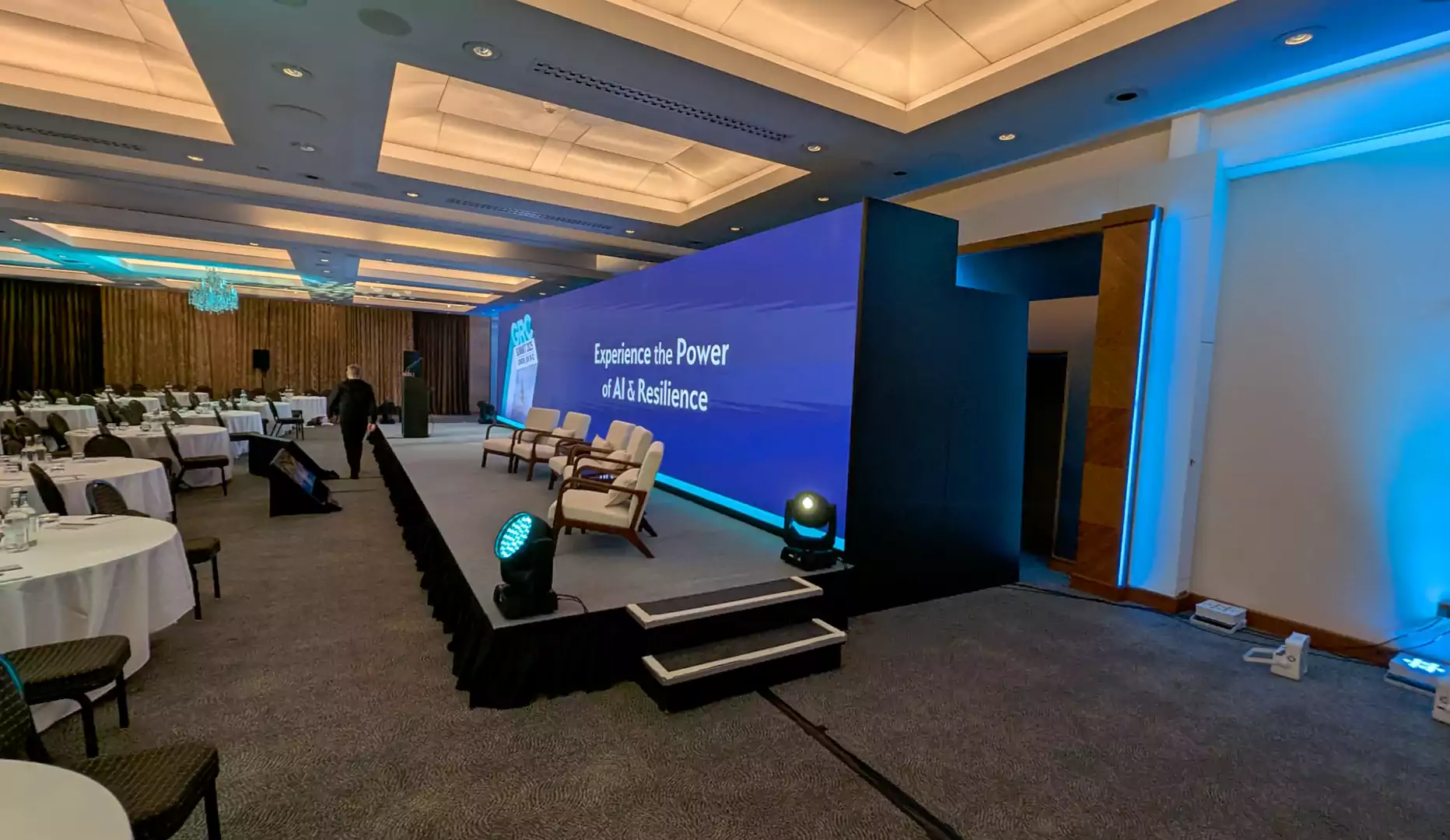
HDR LED walls for live events deliver wider contrast, deeper colours, and more highlight detail than standard LED, but only when the panel, processor, and source content all support HDR end-to-end. For most corporate slide decks, HDR is unnecessary. For cinematic content, brand films, and camera-facing builds, it delivers clear value.
A producer paid extra last season for an “HDR-capable” LED wall at a London product launch. On the day, the visuals looked exactly like a standard rental build. Nothing was broken. The panel could technically receive HDR. There was just no HDR content, no HDR processor mode engaged, and no HDR signal chain. The spec line on the quote did nothing.
That’s the quiet truth about HDR LED walls for live events: HDR is a system, not a panel sticker. The benefits are real when every link in the chain supports HDR, but they disappear when one link does not. This post breaks down what HDR genuinely delivers, what the wall actually needs to display it, and when specifying it is worth the cost.
What Does HDR Actually Deliver on an LED Wall?
HDR delivers a wider range between the darkest and brightest parts of the image, plus a broader colour palette than standard dynamic range (SDR). On an LED wall that means richer blacks, brighter specular highlights that don’t clip to a flat white, and skin tones and product colours that hold their depth instead of washing out.
In practice, three differences are visible when HDR is set up properly:
1. Highlight Detail Survives
A glint on a watch face, a car’s headlight, or a sunlit window can often blow out to plain white in SDR. HDR preserves the gradation, so the highlight reads as bright but still detailed.
2. Shadows Hold Information
Dark scenes show texture and depth rather than collapsing into uniform black. This matters for cinematic brand films and any content with low-key lighting.
3. Colours Sit in a Wider Gamut
HDR pipelines typically work in Rec.2020 or DCI-P3 (wider colour spaces than the Rec.709 used for standard video), so saturated brand colours, product finishes, and graphics look closer to the master file.
HDR (High Dynamic Range) is essentially a contract between the content, the signal chain, and the display, defining how much brightness and colour information the system can carry. SDR throws away information at the top and bottom of the brightness scale; HDR keeps it. On the right wall, with the right source, the difference is obvious. On the wrong setup, you see no benefit at all, which is the trap most “HDR” event quotes fall into.
Why an “HDR-Capable” Panel Isn’t Enough
An HDR-capable panel is only one link in a four-part chain: source content, signal chain, processor, and panel. If any link breaks the chain, the wall outputs SDR no matter what the panel datasheet says.
Most rental LED walls today are bright enough to display HDR-grade peak luminance. Brightness isn’t usually the bottleneck. The real prerequisites planners miss are these:
- HDR-Encoded Source Content
A standard PowerPoint deck or a Rec.709 stock video isn’t HDR, even if your wall is. You need content mastered in an HDR format (typically HDR10, HDR10+, Dolby Vision, or HLG for broadcast pipelines) for HDR processing to do anything.
- A Processor that Supports HDR
Industry-standard LED processors such as Brompton Tessera and Megapixel HELIOS handle HDR signal interpretation, tone-mapping, and 10-bit or higher output. Without an HDR-capable processor in the chain, HDR metadata is stripped.
- 10-Bit (or Higher) Bit Depth End-To-End
SDR runs at 8-bit, giving 256 shades per colour channel. HDR needs at least 10-bit (1,024 shades) to display smooth gradients without banding, especially across skies and skin tones. Every cable, converter, and switcher in the path need to carry it.
- A Panel Calibrated for HDR
A panel that can run in HDR mode still needs calibration so the gamma curve, white point, and colour gamut are right. An uncalibrated “HDR” wall will look worse than a well-calibrated SDR one.
This is exactly the kind of system-level thinking we apply when configuring a rental LED video wall hire : matching the panel to the processor, the processor to the source, and the source to the event brief. It’s also why we always review the technical parameters before quoting any HDR-spec build, because the wrong link in the chain wastes the budget.
| Is HDR the same as higher brightness? No. Brightness is only one input. HDR also requires wider colour, deeper bit depth, the right content, and a processor that knows how to handle an HDR signal. A bright SDR wall is still SDR. |
When to Specify HDR for a Live Event, and When to Skip It
Specify HDR when the content is mastered for it, and the visual difference will reach a paying audience or a camera. Skip it when the content is standard corporate material, the budget is tight, or no one in the chain can deliver HDR end-to-end. Honesty here saves money.
For most conferences and AGMs, where the visuals are slide decks, talking heads, and corporate logos, HDR adds cost without adding much visible value for the audience. The screens already look bright and clean. Where HDR earns its place is anywhere content has been crafted to use it.
| Specify HDR when… | Skip HDR when… |
| Cinematic brand films are central to the show | Content is mostly slides, text, and logos |
| The event is captured for broadcast or live streaming | No HDR-mastered source content is available |
| Product reveals depend on accurate colour and finish | Budget is tight and SDR will look strong already |
| The build is camera-facing (virtual production, in-camera VFX) | The processor or signal chain doesn’t support HDR end-to-end |
| Premium brand activations at venues like ExCeL London or Olympia London | A standard conference at a regional venue with mixed content sources |
The camera angle is worth singling out. HDR’s biggest payoff at live events is often not for the in-room audience but for the cameras capturing the event. Human eyes adapt naturally to a bright LED wall; cameras have a narrower dynamic range and benefit from HDR content optimised for clean capture. For broadcast-facing builds and especially for camera-facing scenarios like XR and virtual production stages using LED walls to replace green screens, HDR is closer to essential than optional.
For an in-room-only corporate audience at Manchester Central, with a deck of slides and one branded video, well-calibrated SDR will likely outperform a poorly implemented HDR build every time. The right question isn’t “do we want HDR?” but “is our source content, signal chain, processor, panel, and budget ready for HDR?”
Final Thoughts
HDR on an LED wall is genuine technology, not marketing, but only when every link in the chain delivers it. The panel, the processor, the signal path, and the source content all have to support HDR for the visible benefit to reach the room or the camera. Where the chain is complete, HDR makes brand films, cinematic content, and broadcast-facing builds look noticeably better. Where it isn’t, an HDR line on the quote is wasted spend.
LED Video Wall Hire is a central London supplier with more than 10 years of experience specifying and operating rental LED walls across UK venues, and is MIA-accredited. If you’re weighing HDR for an upcoming build, talk to us about your content, venue, screen requirements, and signal chain so we can help you decide whether an HDR-ready setup is worth specifying. Call 0207 177 4075 or request a quote by emailing [email protected].
FAQs
What Does HDR Actually Do on an LED Wall?
HDR widens the range between the darkest and brightest parts of the image and expands the colour gamut, compared to SDR. On an LED wall that means brighter highlights without clipping, deeper shadows with detail intact, and more accurate colour reproduction. The visible benefit depends on HDR-mastered content, a supporting processor, and a calibrated panel running together.
Do You Need HDR for Every Event?
No. HDR is worth specifying when content is mastered for it, when the event is camera-facing or broadcast, or when premium brand films drive the show. For standard conferences with slide decks, logos, and talking-head video, HDR usually adds cost without adding visible value. Well-calibrated SDR on a properly specified rental LED wall looks strong on its own.
What Specs Does an LED Wall Need to Display HDR Properly?
The wall needs four things end-to-end: HDR-encoded source content, a processor that supports HDR (Brompton Tessera and Megapixel HELIOS are common in rental), at least a 10-bit signal throughout the chain, and a panel calibrated for HDR with sufficient peak brightness. If any of these are missing, the output falls back to SDR.
