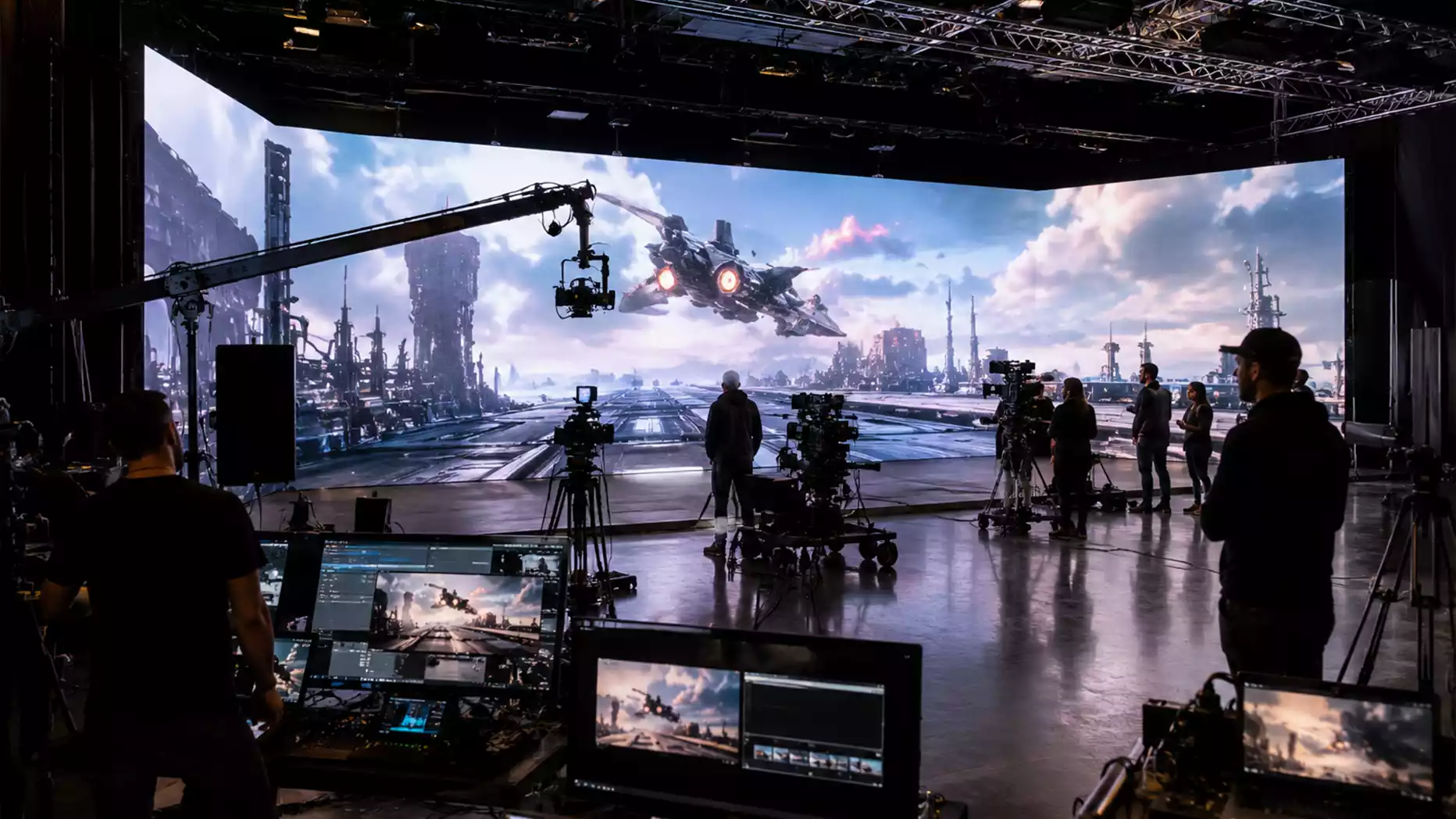
An XR Virtual Production LED Wall replaces the green screen with a bright, real-time LED volume that shows the scene in-camera. Powered by Unreal Engine and processors like Brompton, it is reshaping film and TV. The same cinematic LED look now influences UK live events, conferences, and product launches.
An XR Virtual Production LED Wall is a large array of cutting-edge LED walls arranged into a curved volume, a flat back wall, or a full stage with a floor and ceiling. Instead of a flat green background, the panels display a live photoreal 3D scene rendered by a game engine. The camera films the actor and the virtual environment in one pass.
It is also called an LED volume. The phrase “virtual production stage” usually describes the whole rig: LED panels, a real-time engine, a camera tracking system, an LED processor, and the specialist crew that drives all of it. Supported productions today include feature films, episodic TV, commercials, music videos, automotive shoots, and high-end branded content.
The shift is more than cosmetic. Green screens are subtractive and reflective. An LED wall, however, is emissive. The background stops being a passive surface and becomes a real light source that throws colour, contrast, and reflections back into the scene. That single change is the reason virtual production looks different on camera.
In this guide, you will learn how the technology works, where it earns its day rate, where green screen is still the right call, and what UK productions should ask before booking a volume in London, Manchester, Birmingham, Leeds, Glasgow, or Bristol.
The Anatomy of an LED Volume
Five systems work together to make in-camera VFX possible on a virtual production stage. If one fails, the illusion falls apart.
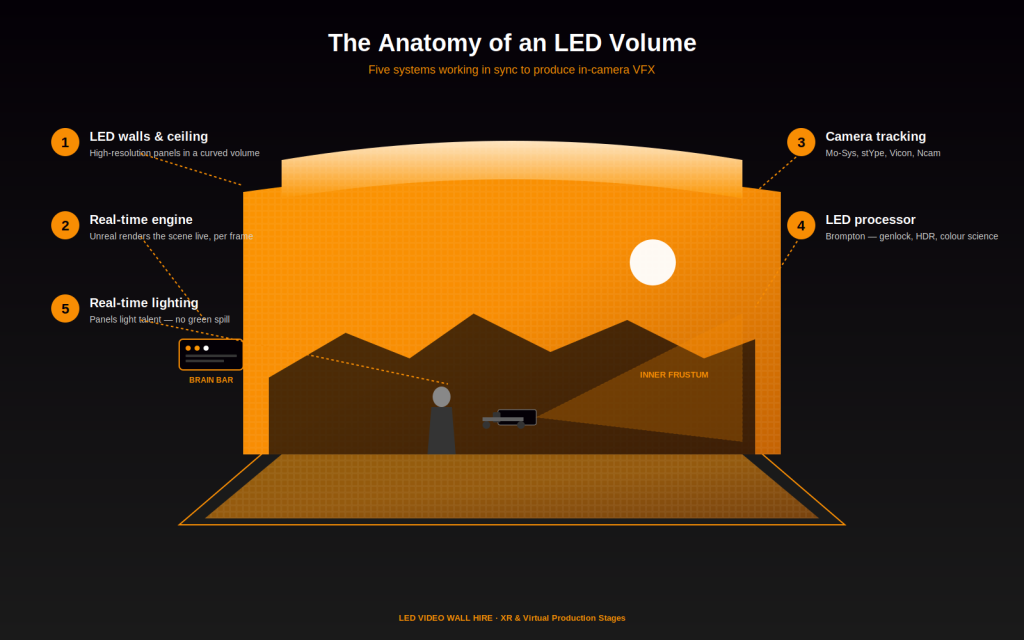
- Led Walls And Ceilings
High-resolution panels display the live background, often in a curved configuration. Larger volumes add an LED ceiling and floor for full-scene immersion.
- Real-Time Rendering Engine
Unreal Engine is the industry default. It draws the 3D environment live, at the camera’s exact perspective, so the world reacts when the camera does.
- Camera Tracking
Sensors and markers report camera position and lens data to the engine many times a second. This is what produces accurate parallax instead of a flat backdrop.
- LED Processor
Brompton Technology is the industry standard. The processor handles genlock, HDR, and camera-grade colour science between the engine and the panels.
- Real-Time Lighting And Reflection
The panels emit light onto talent and props, eliminating the green spill that haunts traditional chroma key shoots.
Why Filmmakers Replace Green Screen with LED Wall UK Studio Setups
Green screens are not broken. They are still the right tool for fully CG environments and tight budgets. However, for live-action work with real talent in believable places, LED volumes solve five problems that green screens have always carried.
1. Light That Actually Exists
A green screen lights the actor with stage lamps. An LED wall, by contrast, lights the actor with the scene. If the shot is a sunset, the sunset is on the panels behind them. Therefore, the warm light hits their face from the right direction, and skin tones look correct without colour-matched lighting rigs working overtime to fake the spectrum.
2. Reflections That Read On Screen
Anything chrome, glass, wet, or polished is a nightmare in front of green. The Mandalorian’s beskar armour is the classic example. A green-screen comp would have meant painting reflections back in by hand on every shot. On an LED volume, the reflections are already correct because they reflect the real environment.
3. A Performance, Not A Guess
Actors are better when they can see what they are reacting to. A spaceship cockpit feels like a cockpit. A desert horizon gives them a real line of sight. As a result, directors, DOPs, and gaffers can make creative decisions on the day with the environment in the room, not on a tablet preview.
4. Final-Pixel Capture
When the background is captured in-camera, you skip rotoscoping. You skip keying chroma off hair and props. You skip the relight pass to match plates. Many shots come off the camera at or near final quality. Pickups still happen, and VFX is still in the pipeline, but the bulk of the comp moves from post to pre, where it is cheaper to plan and easier to change.
5. Creative Flexibility On The Day
Sets change at the speed of software. The golden hour can be held indefinitely. A scene can move from a desert at noon to a snowfield at dusk between takes. Therefore, one stage can stand in for a dozen locations in a single shooting day.
See our guide on LED screens for virtual productions for stage configurations, technical specs, and more.
How Does an LED Volume Work on a Virtual Production Stage Setup in the UK?
Behind the panels sits an orchestrated chain of hardware and software, with each piece doing one job well.
- Real-Time Engine and the Camera Frustum
Most virtual production volumes run Unreal Engine. A Virtual Art Department builds the scene in pre-production, then the engine renders it live on the day. The patch of the wall the camera is actually looking at, called the “inner frustum”, gets the highest render quality. Meanwhile, the rest of the wall renders at lower fidelity, where its main job is to throw colour and light onto the set.
For background on the engine itself, see Epic Games’ Unreal Engine virtual production resources.
- Camera Tracking Systems for Virtual Production in the UK
Tracking systems such as Mo-Sys, stYpe, Vicon, and Ncam feed camera position and lens data back to the engine. Lower-cost alternatives now exist for indie and mid-tier work, making camera tracking virtual production UK setups available outside the top end. This link between the physical lens and the digital world is what gives a moving camera correct parallax.
- Brompton Processor LED Wall Studio Pipeline
An LED processor sends the rendered image to the panels with the colour science, HDR pipeline, and genlock that filmmaking demands. Brompton processor LED wall studio setups are common because they handle the camera-grade colour and refresh rates film cameras need. Alternatives include Megapixel and similar broadcast-grade controllers.
- LED Wall Refresh Rate Camera Sync UK
Cinema cameras can show flicker, banding, and moiré when LED walls are not refresh-locked to the shutter. Therefore, a virtual production volume genlocks the camera, the processor, and the panels so the wall and the camera “see” each other on the same frame. LED wall refresh rate and camera sync should be one of the first technical conversations you have with a UK supplier.
- LED Wall Pixel Pitch For Film UK Shoots
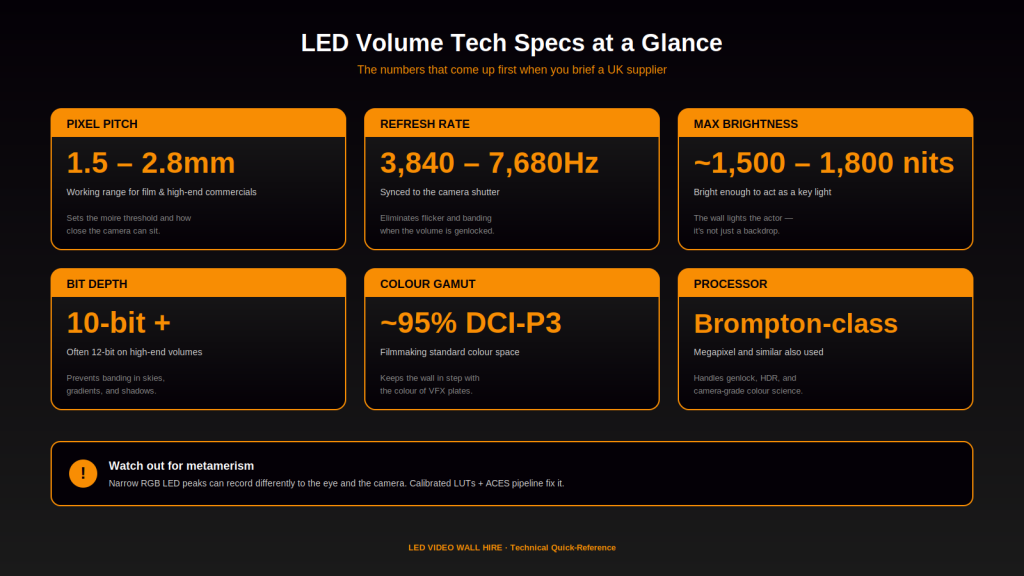
LED wall pixel pitch for film UK shoots typically ranges between 1.5mm and 2.8mm. Finer pitch means sharper close-ups and fewer moire risks. Brightness sits around 1,500 to 1,800 nits at the top end, which is enough for the wall to function as a key light. In addition, panels target roughly 95% DCI-P3 with 10-bit or higher depth, keeping the volume in step with the colour space used by VFX plates.
There is one quiet trap to know about: metamerism. Because LED light is made of narrow red, green, and blue peaks rather than a continuous spectrum, two things that look the same to the eye can be recorded differently on a camera sensor. Good volumes, therefore, correct for this with carefully calibrated LUTs and a linear colour pipeline, usually ACES. It is worth asking your supplier about this before the shoot.
Before you commit, walk through the technical checks before renting an LED wall: pixel pitch, brightness, processor, sync, and structural fit all matter more for film than for events.
A quick reference for the numbers that come up most often in supplier conversations:
| LED Specification | Working Range For Film | Why It Matters On A Shoot |
| Pixel pitch | 1.5mm – 2.8mm | Sets the moire threshold and how close the camera can sit |
| Refresh rate | 3,840Hz – 7,680Hz | Eliminates flicker and banding when synced to the camera shutter |
| Max brightness | ~1,500 – 1,800 nits | Lets the wall act as a key light, not just a backdrop |
| Bit depth | 10-bit or higher | Prevents banding in skies, gradients, and shadows |
| Colour gamut | ~95% DCI-P3 | Keeps the wall in step with VFX plates |
| Processor | Brompton or equivalent | Handles genlock, HDR, and camera-grade colour science |
Green Screen vs LED Wall: A Side-by-Side for UK Productions
Neither workflow is universally better. The comparison looks like this.
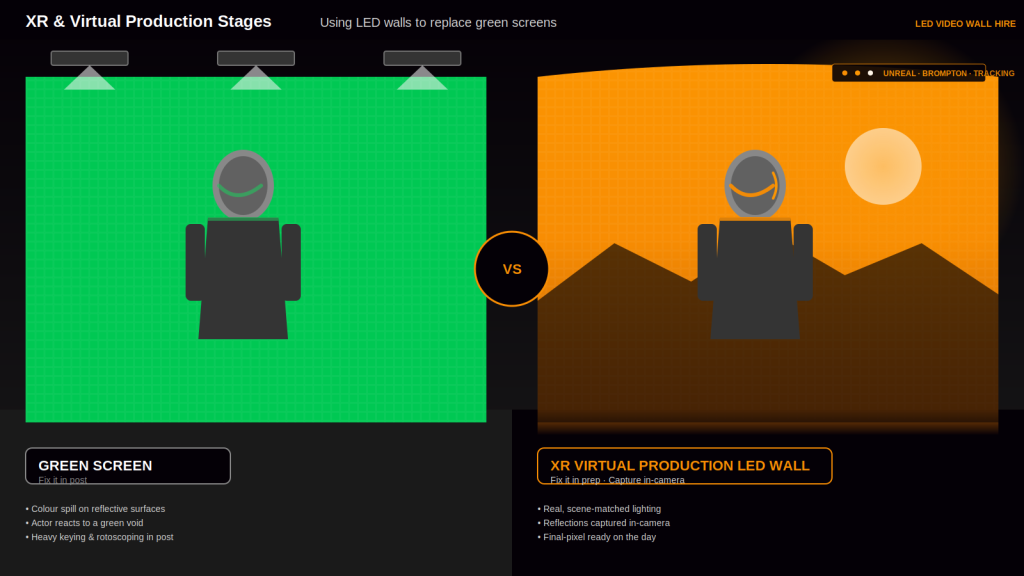
| Factor | Green Screen | XR Virtual Production LED Wall |
| Physical principle | Passive, reflective surface | Active, emissive light source |
| On-set view | Green void; the scene is imagined | Final scene visible behind the actor |
| Lighting on talent | Stage lamps fight constant colour spill | Scene-matched light from the panels themselves |
| Reflective costumes & props | Green spill destroys reflections | Reflections show the actual environment |
| Actor performance | Reacting to imagination | Reacting to a visible world |
| Camera moves & parallax | Simulated in post | Real-time and dynamic |
| Post-production load | Heavy keying, rotoscoping, comp, relight | Often, “final pixel” in-camera |
| Day-rate cost | Lower up front | Higher up front, lower in post |
| Best fit | Full CG worlds, simple keys, tight budgets | Live-action with real talent in believable environments |
From “Fix It in Post” to “Fix It in Prep”
The biggest change virtual production brings is not a hardware change. It is a workflow change. Decisions that used to live in post, such as colour, lighting, set extension, and sky replacement, now have to be locked before principal photography. As a result, the shoot becomes more iterative and more collaborative.
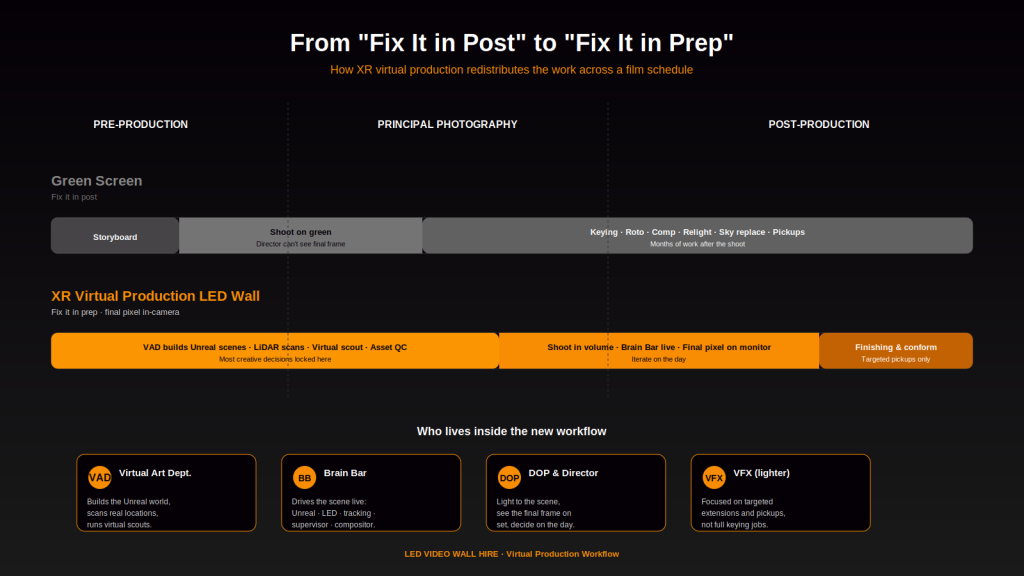
- The Virtual Art Department (VAD)
A VAD is the team responsible for building the digital environments that appear on the LED wall. They scan real locations with LiDAR or photogrammetry, build sets in Unreal, and run virtual scouts so the director and DOP can walk a location in VR before the physical stage is built. Their work begins months before the camera rolls.
- The Brain Bar
Off-stage but in earshot, the Brain Bar is the command desk where the digital scene is driven during the take. A virtual production supervisor, an Unreal operator, a scene technician, an LED engineer, and a tracking specialist sit here. They can move a virtual sun, dim a light card, swap an environment, or push a new prop into the scene between takes. This is the part of the day that does not exist on a green-screen shoot at all.
- Hybrid Workflows: Virtual Set Extension Led Wall UK Shoots
Many productions use both. The LED wall handles mid-ground and atmospheric lighting, while a small green-screen section is used for distant background extensions or specific set replacements. This hybrid approach keeps the lighting benefits of the volume while preserving the flexibility of traditional comp for shots that need it.
Productions That Proved It Works
Three landmark shoots show how LED volumes have scaled from experiment to standard tool.
The Mandalorian (Lucasfilm / ILM)
Industrial Light & Magic’s StageCraft volume, a 20-foot-tall, 270-degree curved LED wall with an LED ceiling, built from 1,326 individual panels, shot more than half of Season 1. The screens used a 2.84mm pixel pitch, and ROE Visual Black Pearl BP2 panels capable of around 1,800 nits, bright enough to act as a key light on Mando’s reflective armour. The production switched between planets in minutes rather than days.
1899 (Netflix / Studio Babelsberg)
Framestore designed an LED volume on a physical rotating stage for the Netflix series 1899. The entire set could therefore turn 360 degrees rather than being rebuilt for reverse shots. To render the vast ocean environments, the team tuned the Unreal pipeline for dual-GPU performance.
The Batman (Warner Bros. / Greig Fraser)
Cinematographer Greig Fraser used LED volumes to anchor Gotham’s perpetual rain and neon. Actors could see the skyline rather than a green void, which helped the performance. Fraser has been public about treating the volume as one tool among many, not a wholesale replacement for traditional sets and locations.
When Green Screen Still Wins
An honest brief includes when not to use the technology. Stick with green screen if the shot needs a fully CG environment with no real interaction, such as a space dogfight. The same applies if the budget cannot absorb a Brompton-class processor and an Unreal operator. Also consider green screen if the shoot is mostly tight close-ups where the background never resolves, or if talent needs to fly on a wire rig that does not play well with an enclosed volume. There is no shame in keying. Many big-budget films still do most of their work that way.
What the XR Era Means for UK Live Events
Here is the interesting part for anyone planning a live event in the UK. The cinematic LED look that virtual production made famous is now reshaping what audiences expect from a corporate stage, a product launch, or a brand activation. The hardware is closer than most people realise.
The Unreal-rendered environments, the camera tracking, and the specialist Brain Bar crew belong to film and TV. But the LED panels themselves, the bright, sharp, seamless walls that make the cinematic look possible, are the same family of displays used at the high end of the UK events market. As a result, event organisers are now borrowing four ideas directly from virtual production.
1. Curved and Immersive Stage Backdrops
Curved LED walls turn a flat conference stage into a wraparound environment. Audiences feel inside the brand world rather than watching slides. The technology is the same; the content is built for the room rather than the camera.
2. Bright Walls That Double As The Lighting Design
Just as an LED volume lights actors, a bright event LED wall lights the speaker and the front row. Therefore, venues need fewer fixtures, and the colour temperature on stage matches the visuals behind it.
3. Cinematic Depth On A 2D Wall
Pre-rendered Unreal Engine environments, parallax loops, and depth-of-field content are crossing over from film into event content. A keynote can open with a flythrough of a virtual cityscape and land on the speaker, without any of the camera tracking complexity behind it.
4. Real-Time Content Swaps Between Sessions
Borrowed from the Brain Bar mindset, modern event AV teams now treat stage content as live and editable rather than baked. Sponsor logos, language tracks, and even environment themes can be swapped between sessions without rebuilding a set.
If you have seen virtual production in a film and wondered how that look translates to your conference, product launch, or awards night, this is the crossover. LED Video Wall Hire works with event organisers across Central London using the same panel families that sit behind those cinematic walls, applied to live audiences, not film cameras. For a clearer view of how event LED stages are evolving, the in-depth post on the different roles LED video walls play in live and virtual events is a good place to start.
Planning a Live Event in London? Talk to LED Video Wall Hire
Virtual production may belong to film studios, but the same cinematic LED look is reshaping conferences, product launches, fashion shows, and award nights across the UK. LED Video Wall Hire is an experienced Central London LED video wall hire team, with the panels, technicians, and stage know-how to bring that high-end look to your event.
To talk specifics for your event, get in touch.
And keep an eye on what comes next. Neural rendering techniques such as 3D Gaussian Splatting are starting to make photoreal environments faster and cheaper to build. Therefore, the cinematic LED look that used to belong only to blockbuster pipelines is steadily filtering down into the rooms where UK audiences gather every week.
FAQs
What is an XR Virtual Production LED Wall?
An XR Virtual Production LED Wall is a large, high-resolution LED screen that shows the scene live behind the actors, so the camera captures the environment and the performance in the same frame. A real-time engine like Unreal renders the image, which updates as the camera moves. That parallax is what separates it from a printed backdrop or a static screen.
Is in-camera VFX LED wall UK production cheaper than green screen overall?
It depends on the project. The day rate for an LED volume is higher than a green-screen stage, but post-production keying, relighting, and comp time often drop sharply. For shows with reflective talent, lots of set extensions, or tight delivery timelines, the total cost can land lower than green screen by the time the master is delivered.
Why does LED wall pixel pitch for film UK shoots matter so much?
Film cameras get close, change focus, and shoot at shallow apertures. A pitch that looks fine to the human eye at five metres can show pixels or moire patterns on a sensor. For film and high-end commercials, a pitch between roughly 1.5mm and 2.8mm is the working range, with a finer pitch used for closer hero work.
