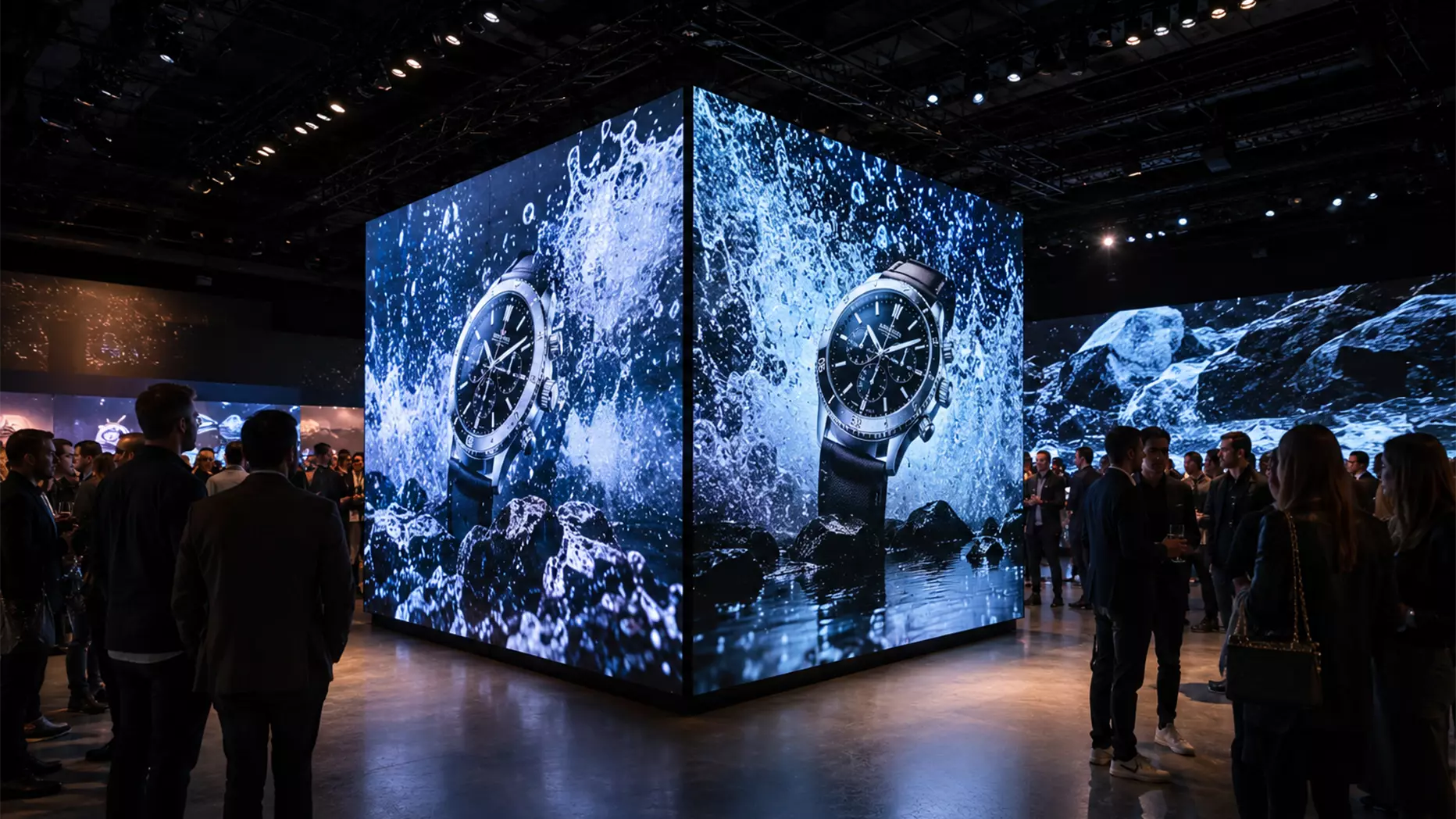
Immersive LED Rooms and LED Cubes are walk-in, 360-degree spaces built from modular LED panels that surround audiences with synchronised content on every surface. UK brands hire them for product launches, exhibitions, and corporate activations because they drive stronger recall, longer dwell time, and built-in social shareability.
An immersive LED Room is a walk-in space with seamless LED panels on every surface, surrounding the audience with synchronised 360-degree content. Brands hire these rooms and LED Cubes to create high-recall moments at product launches, exhibitions, and corporate events. Generally, builds in the UK use 2.6mm modular panels and need a footprint of 4m x 4m or larger.
In an age where attendees scroll past static banners and forget keynote slides within hours, brands have started chasing something more powerful: full-sensory walkthrough moments that audiences cannot ignore. That is exactly where immersive LED rooms and LED cubes come in. These structures wrap visitors inside a 360-degree canvas of light, motion, and sound, turning a corporate stand or a product launch into a story your audience physically steps into.
If you are planning a launch at ExCeL London, a brand activation at Olympia London, or a roadshow that travels to Manchester Central and Birmingham, this guide will walk you through how immersive LED Room hire UK works, what it costs to build, and how to design a 360-degree experience that genuinely lifts brand recall.
What Is an Immersive LED Room?
An immersive LED Room is a fully enclosed walk-in space built from seamless LED panels. The audience stands inside the screen rather than watching it.
The setup uses modular LED panels, so the size and shape match your venue. Builds range from a 4m x 4m brand cube on an exhibition floor to a 10m walkthrough tunnel inside a conference hall. The result is a 360-degree LED Wall environment that surrounds visitors with synchronised content on every surface, including walkable LED floors that can respond to footsteps when paired with motion sensors.
What Is an LED Cube?
An LED Cube is a self-contained LED cube structure. It usually has four to six LED-clad faces. It can sit on a show floor as a centrepiece, hang above a stage as a brand totem, or work as a walk-in micro-room for small groups.
LED Cubes work well at corporate events because they are visible from every angle, easy to brand with synchronised live content display, quick to install, and modular. For brands that want a strong visual presence in a compact footprint, a cube delivers more impact than a flat wall of the same size.
How Are the Corners Made Seamless?
The biggest technical challenge in any LED Cube or immersive room is the 90-degree corner where two walls meet. Standard LED cabinets have visible frames. When two are joined at an angle, the result is an ugly vertical line that breaks the illusion.
The solution is bevel-edge LED cabinets. These panels have 45-degree mitred edges, so two cabinets join cleanly at 90 degrees with zero visible gap. When you brief a supplier, ask directly whether they use bevel-edge panels for corners. If they do not, your cube will look like four flat walls bolted together rather than one continuous environment.
Walkable LED Floors: The Fourth Surface
A true 360-degree experience treats the floor as part of the canvas. Walkable LED floor panels are built differently from wall panels. They need to handle weight, resist slipping, and survive trolleys and stilettos. Specifications to ask for when hiring:
- Load capacity of at least 2,000kg per square metre to support crowds and equipment.
- Tempered glass overlay for protection and slip resistance.
- Matte, anti-glare finish so the wall content does not reflect off the floor.
- Pitch matching between floor and wall panels so the image reads as one continuous surface.
Pressure-sensing floors can also detect where attendees stand and trigger content responses, opening the door to interactive activations.
Why Brands Are Choosing 360-Degree LED Wall Experiences
Flat displays inform. Immersive environments make people do something. They turn their heads, walk through, take a photo and share it. That behaviour is exactly what experiential marketing teams are paid to create.
Here is what a 360-degree setup delivers that a single screen cannot:
- Stronger brand recall: Multi-sensory environments imprint more deeply than passive viewing.
- Built-in shareability: Immersive rooms are designed to be photographed, turning every attendee into a content distributor.
- Layered storytelling: Sky on the ceiling, product on the front wall, behind-the-scenes content on the side walls, all running together.
- Versatility: The same modular kit can serve a product launch in London on Monday and a stage backdrop in Birmingham on Friday.
For more brand-engagement tactics, read our guide on the newest ways to engage your audience using LED video walls.
Where Immersive LED Rooms Work Best
Not every event needs a 360-degree setup. However, the formats below almost always benefit from one.
- Product Launches
For a 360 LED product launch in the UK, brands often build a sealed cube. Small groups enter, watch a 90-second cinematic reveal play across every wall, and exit straight into the product demo. The result is a controlled, uninterrupted moment.
- Exhibitions and Trade Shows
At ExCeL London and Olympia London, your stand competes with hundreds of others. A walkthrough LED experience for a corporate event turns your booth into a destination. It lifts dwell time and conversation quality.
- Conferences and Keynotes
Used as a stage backdrop, a curved or three-sided LED wall makes the speaker part of a larger visual story rather than someone standing in front of a slide.
- Brand Activations and Pop-Ups
Immersive brand activation LED walls in London are increasingly used for short, high-impact pop-ups in shopping centres, public spaces, and flagship store launches. The goal is to increase reach and brand awareness.
- Corporate Hospitality and Awards Nights
For award ceremonies and gala dinners, an immersive LED Room creates a cinematic environment. It lifts the whole evening from a standard conference dinner to a memorable showcase.
How to Build an Immersive LED Room for Events?
Here is how a typical build unfolds, based on projects we have delivered across UK venues.
Step 1: Define the Goal and Footprint
Before specifying hardware, agree on what the space needs to do. A queue-and-enter walkthrough, a photo moment, and a keynote stage all need different dimensions and content styles. Lock the goal first.
Step 2: Choose the Right Pixel Pitch
Pixel pitch is the distance between LED dots. The smaller the pitch, the sharper the image up close. The industry rule of thumb is roughly 1mm of pitch for every 3 metres of viewing distance.
Use this as a quick reference:
| Pixel Pitch | Best Viewing Distance | Typical Use Case |
|---|---|---|
| 1.5mm | 1.5m – 3m | Premium close-viewing, executive events, broadcast |
| 2.6mm | 2.5m – 5m | Standard immersive rooms, product launches |
| 3.9mm | 4m – 8m | Large-format stage backdrops, budget builds |
For immersive rooms where attendees stand within two metres of the wall, 2.6mm is the practical sweet spot for cost versus quality. Anything coarser will look pixelated at close range.
Step 3: Plan the Structure
LED Cube Structures need a rigging or ground-support system that holds the panels safely and securely. Venue ceiling height, floor loading, and access routes all influence what is possible. Modular LED panel hire UK helps here, because the kit can be reconfigured for nearly any venue. For tight venues, ask whether your supplier uses front-service panels; they don’t need maintenance space behind the wall.
Step 4: Create the 360 Content
Standard 16:9 video does not work in a 360 environment. Content must be authored for the specific wall layout, with the “sweet spot” viewing position fixed before storyboarding starts. Anamorphic content with forced perspective is the most effective format because it uses the cube’s geometry to create a sense of depth.
Brief your creative agency at least six to eight weeks in advance of the event. 360 content creation LED walls typically use a media server that drives every panel from a single synchronised timeline, so visuals stay aligned across every corner.
Step 5: Test, Calibrate, and Run
Once installed, panels are colour-matched and brightness-balanced so the entire surface reads as one continuous image. On show day, an on-site technician monitors playback and resolves any issues live.
If your event has both an in-room and online audience, the same setup can stream cleanly to remote viewers. We covered this in detail in our piece on LED video walls for live and virtual events.
How to Choose the Right Partner for Immersive LED Room Hire UK
Not every AV supplier can deliver a true immersive build. When shortlisting providers, ask these questions:
- Do they own the panels, or are they sub-hiring? Owned stock means tighter quality control.
- Can they showcase studies of LED Cube hire for corporate events UK projects of similar scale?
- Do they provide on-site technicians for the full event?
- Can they advise on content authoring for curved or multi-sided walls?
- Are they accredited by industry bodies such as the MIA?
At LED Video Wall-Hire, every immersive build is backed by 10+ years of delivery experience across London, Birmingham, and Manchester. Our 2.6mm panels, modular cube structures, and full-service technical team mean you get one accountable partner from concept to show day.
What’s Next for Immersive LED?
Two trends are shaping the next wave of UK brand activations: transparent LED panels that turn glass walls into displays without losing visibility, and AI-driven content that adjusts in real time to audience demographics or time of day. Both are already appearing in flagship retail and hospitality builds, and will likely be accessible for event hire within the next two years.
Plan Your 360-Degree Brand Moment
Immersive LED Rooms and Cubes are no longer reserved for the biggest tech launches. They are becoming the default for brands that want to be remembered after the event ends.
If you are scoping a build, talk to our team at 0207 177 4075 or email us at [email protected]. We will walk you through panel options, structural feasibility, and a budget aligned to your goals.
FAQs
What Is Immersive Led Room Hire Uk?
Immersive LED Room Hire UK is a rental service where modular LED panels are built into an enclosed, walk-in space. The walls, and often the floor and ceiling, display synchronised content. The audience is surrounded by a 360-degree visual experience.
How Much Space Do I Need for an LED Cube?
A four-sided walk-in cube typically needs a 4m x 4m footprint, plus rigging clearance. Smaller totem-style cubes fit into a 2m x 2m. We survey the venue before quoting.
Can The Same Led Kit Travel To Multiple Venues?
Yes. Modular LED panel hire UK is designed for this. The same panels reconfigure into different shapes at each stop on a roadshow.
What Is The Difference Between An Led Cube And A 360-Degree LED Wall?
An LED Cube is a closed structure with four to six faces. A 360-degree LED Wall is usually a curved or multi-sided open wall that surrounds the audience without enclosing them. Choose a cube for walk-in moments and a curved wall for wraparound stage environments.
Do You Provide Content Creation As Well?
We focus on hardware, structure and technical delivery. We work alongside your creative team to make sure visuals are authored correctly for the wall layout.
Which UK Venues Are Best Suited To Immersive LED Installations?
ExCeL London, Olympia London, Manchester Central, and major Birmingham venues have the ceiling height, floor loading, and power infrastructure needed for large immersive builds. Smaller cubes fit comfortably into most hotel ballrooms and conference suites.
